

As global parcel volumes climb past 200 billion shipments per year, the pressure on sorting infrastructure has never been greater. Warehouses and distribution centers must process more items, more accurately, and with shorter cut-off times. The swivel wheel sorter — a servo-driven, modular sortation system — has become one of the most cost-effective ways to achieve high throughput while maintaining gentle handling. In this article we examine how swivel wheel sorter technology is evolving in 2026, where it is deployed, and what the next wave of innovation looks like for operators worldwide.
The Zowinda high-efficiency swivel wheel sorter is an intelligent sorting integrated system that combines servo drive, intelligent control, and advanced recognition technology. It is engineered specifically for e-commerce logistics, central warehousing, express delivery, and industrial sortation scenarios. Relying on modular wheel groups and intelligent dispatching systems, it automates the transport, identification, diversion, and precise classification of goods — delivering high sorting efficiency, wide product adaptability, and extremely low error rates that significantly raise the level of logistics automation.
| Parameter | Specification |
|---|---|
| Sorting Capacity | Up to 20,000 pieces / hour (entry models from 6,000) |
| Item Size Range | 100 x 100 mm to 600 x 600 mm |
| Item Weight Range | 10 g – 30 kg |
| Sorting Accuracy | 99.9% and above |
| Number of Outlets | Configurable 6 – 40+ outlets |
| Conveyor Speed | 0.5 – 2.5 m/s adjustable |
| Recognition Technology | Barcode, QR Code, OCR, RFID (optional) |
| Power Supply | 380V / 50Hz or custom voltage |
The swivel wheel sorting principle is elegantly simple yet highly effective. Items are first induced onto the main conveyor line at controlled intervals to maintain spacing. Barcode scanners, OCR cameras, or RFID readers then capture each item’s destination, and the control system computes the optimal outlet, optimizing chute utilization in real time. At the precise position, a swivel wheel activates and gently pushes the item into the target chute with servo-level accuracy, after which sorted items accumulate in designated bins or flow to downstream conveyors for packing and dispatch.
The sortation equipment market is undergoing its most significant shift in a decade. Four converging forces — artificial intelligence, modular engineering, sustainability mandates, and chronic labor shortages — are redefining what operators expect from a sorter. Here is where the technology is heading in 2026.
In 2026, the sorter is increasingly a software product wrapped around a mechanical core. Machine-learning routing engines now predict congestion before it happens, dynamically rebalancing chute assignments to keep throughput steady during peak surges. Vision-based dimensioning feeds downstream packaging systems, while anomaly detection flags misreads and exception items for automatic recirculation rather than manual intervention. The result is a system that gets smarter the longer it runs.
Four proven configurations — Linear (single straight line for simple A-to-B flows), L-Shaped (90-degree turns for space-efficient multi-discharge layouts), Loop (closed-loop recirculation of unsorted or exception items), and Multi-Level (stacked systems maximizing capacity in limited floor space) — mean a single platform can be tailored to almost any footprint. In 2026, providers are shipping these as standardized modules that can be re-deployed as business needs change, turning capital equipment into flexible infrastructure.
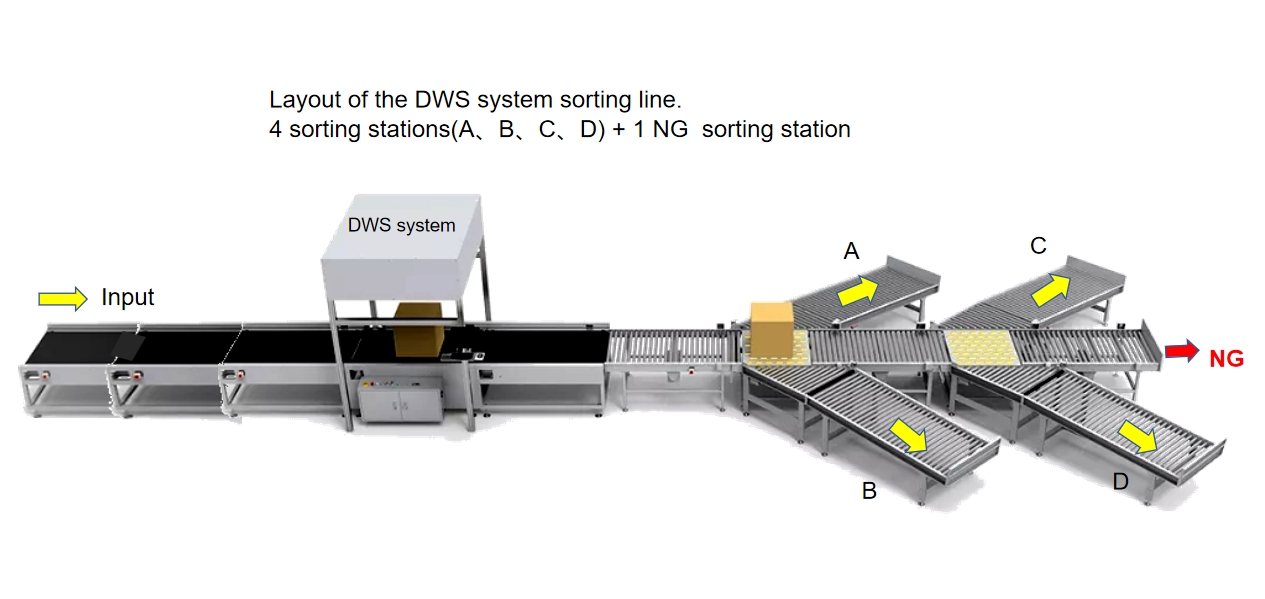
Dimensioning, Weighing, and Scanning (DWS) stations are no longer bolt-on accessories. Modern swivel wheel lines embed 4+1 DWS stations directly into the induction zone, capturing dimensions, weight, and barcode data in a single pass. This supports accurate shipping-cost calculation, fraud reduction, and real-time inventory visibility — capabilities that have become table stakes for 3PLs serving omnichannel retailers.
With energy costs and carbon reporting now board-level concerns, 2026 sorters emphasize regenerative servo drives, intelligent sleep modes during low-volume windows, and sub-70 dB acoustic profiles that let facilities comply with workplace noise regulations without costly enclosures. Lower maintenance (fewer moving parts than tilt-tray alternatives) further reduces lifetime cost and downtime.
Supply-chain volatility has made resilience a primary purchase criterion. Loop and multi-level configurations let exception items recirculate automatically, while redundant control paths keep the line running if a scanner or diverter faults. Operators increasingly favor architectures that degrade gracefully rather than halt entirely.
The versatility of the swivel wheel sorter makes it a strong fit across a widening range of sectors and order profiles:
The global sortation systems market continues to expand at a healthy double-digit compound annual growth rate, propelled by structural e-commerce growth, rising same-day and next-day delivery expectations, and sustained labor shortages. The Asia-Pacific region — led by China’s dense, high-volume fulfillment networks — remains the fastest-growing adoption zone, while North American and European operators modernize aging tilt-tray fleets with quieter, more efficient swivel wheel lines.
A notable 2026 development is the convergence of sortation with broader warehouse execution systems (WES) and robotics. Swivel wheel sorters are increasingly offered as nodes within an orchestrated, software-driven facility rather than standalone islands, enabling end-to-end visibility from induction to dispatch. For buyers, this means evaluating not just mechanical specs but the openness of APIs, the quality of the routing software, and the vendor’s AI roadmap.
| Feature | Swivel Wheel | Tilt Tray | Cross Belt |
|---|---|---|---|
| Gentle Handling | Excellent | Good | Moderate |
| Maintenance Cost | Low | Medium | Higher |
| Footprint | Compact | Large | Very Large |
| Noise Level | Quiet (<70 dB) | Moderate | Louder |
| Initial Investment | Lower | Higher | Highest |
In 2026, the swivel wheel sorter stands out as a pragmatic, future-ready choice for operators who need enterprise-grade throughput without enterprise-grade footprint or maintenance burden. With capacities reaching 20,000 pieces per hour, accuracy above 99.9%, and a modular architecture that adapts to Linear, L-Shaped, Loop, and Multi-Level layouts, it addresses the core challenges of modern logistics head-on. As AI routing, native DWS, and energy-efficient servo drives become standard, the technology is well positioned to remain a cornerstone of automated sortation for the decade ahead.
Sorter
Wechat QR code
wechat number:Copyright © 2022-2023 Winda, inc. All rights reserved