

As global parcel volumes cross new records in 2026, the bottleneck is no longer transport but the speed and accuracy of the first and last sort. The High-Efficiency Swivel Wheel Sorter built around a DWS (Dimensioning, Weighing, Scanning) system with 10 sorting stations plus 1 NG (No-Read) station has emerged as one of the most pragmatic answers to that challenge.
Logistics AutomationDWS IntegrationSwivel Wheel Sorter2026 Trends
Logistics operators in 2026 are processing well beyond 10,000 items per hour during peak windows, yet the tolerance for misrouting has shrunk to near zero. Three forces converge:
Traditional single-line systems and older pop-up wheel sorters struggle on all three fronts. The configuration profiled here was engineered to close that gap.
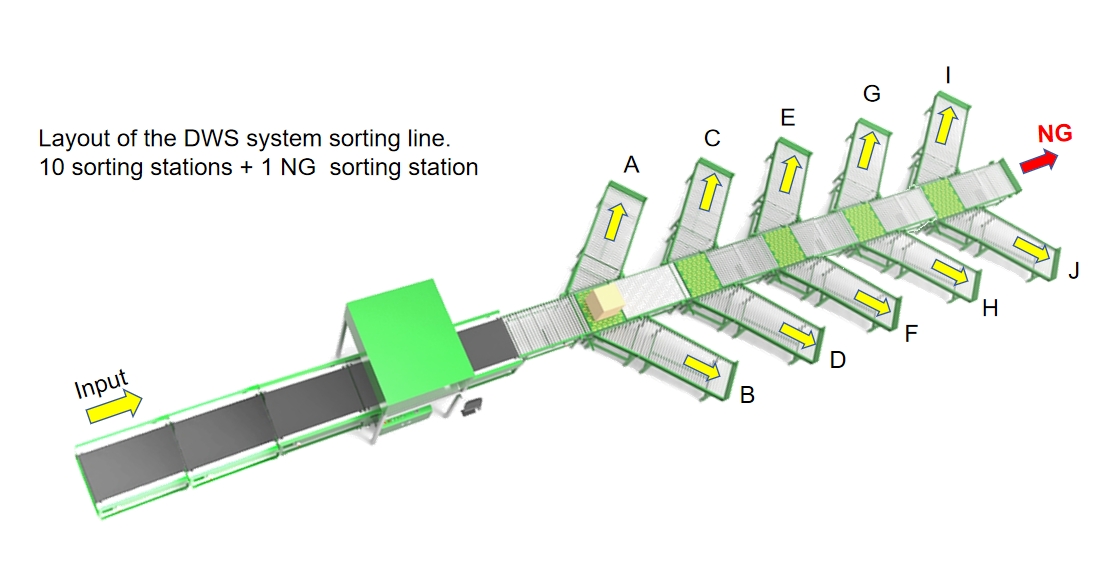
The High-Efficiency Swivel Wheel Sorter is laid out as a complete DWS system sorting line: a dimensioning and weighing tunnel feeds high-speed omnidirectional scanners, and the data stream drives a swivel wheel sortation matrix of 10 configurable sorting stations plus a dedicated NG station. A parcel is measured, weighed, and identified in milliseconds, then diverted to the correct destination chute without human touch.
At its core is a PLC + SCADA + IoT control architecture, giving operators centralized monitoring, predictive maintenance alerts, and remote diagnostics that turn the sorter into a manageable node in the wider warehouse control system.
| Parameter | Specification |
|---|---|
| Sorting stations | 10 configurable outlets + 1 NG (No-Read) station |
| Throughput capacity | 6,000 - 8,000 items / hour |
| Sorting accuracy | Greater than or equal to 99.9 percent |
| Parcel size range | 50 x 50 x 10 mm to 600 x 500 x 400 mm |
| Parcel weight range | 0.01 kg - 30 kg |
| Dimension accuracy (DWS) | Plus or minus 5 mm |
| Weight accuracy (DWS) | Plus or minus 10 g |
| Scanning speed | Up to 3.5 m/s |
| Barcode support | 1D (Code 128, EAN, UPC), 2D (QR, DataMatrix) |
| Communication interfaces | TCP/IP, RS232, USB |
| Control system | PLC + SCADA + IoT |
| WMS / WCS compatibility | SAP EWM, Manhattan, Blue Yonder, Oracle, Infor, Custom API |
Ten dedicated outlets let the system route parcels by ZIP code, carrier, service level, or any custom rule. Re-routing is a software change, not a mechanical rebuild.
Instead of stopping the line when a barcode is damaged, obscured, or missing, the parcel is automatically diverted to the NG station for manual scan or key-entry, eliminating the most common cause of line stoppages.
Laser or infrared sensors capture parcel dimensions in milliseconds, integrated scales record weight, and omnidirectional scanners read barcodes at line speed. The result is a complete, auditable data record per parcel.
All DWS data is pushed to the warehouse management or control system, enabling dynamic routing, accurate billing, and live dashboards.
Any station, including NG, can be re-tasked as a regular outlet or vice versa in 2 to 4 hours, protecting the investment against shifting volume and seasonal peaks.
Connected sensors flag wear and anomalies before they cause downtime, shifting maintenance from reactive to scheduled.
The standalone sorter is disappearing. In 2026, buyers expect DWS, sortation, and WMS to behave as one system. The 10+1 configuration is a textbook example of integration-first design.
NG handling has moved from an afterthought to a design priority. Operations now measure throughput at the system level, including how gracefully exceptions are absorbed.
Routing logic lives in software. Reconfiguring stations and rules without mechanical change is now a baseline expectation, not a premium feature.
With warehouse labor hard to hire and retain, automation ROI is increasingly justified by headcount avoidance rather than pure speed. A 60 to 75 percent reduction in manual sorting labor is the headline number operators cite.
For operations processing 5,000 or more parcels per day, the typical payback period for a 10-station swivel wheel sorter with DWS is 18 to 24 months. The primary ROI drivers are labor cost reduction (60 to 75 percent) and accuracy improvement (from roughly 99.2 percent to 99.9 percent plus). DWS integration adds 6 to 12 months to payback but pays for itself through accurate dimensional weight calculation and fewer carrier billing disputes.
Yes. The modular design allows any station, including NG, to be reconfigured as a regular outlet or vice versa, typically within 2 to 4 hours and with minimal tooling.
The intelligent DWS reads all visible barcodes and applies priority logic to select the correct one, usually the shipping label. Ambiguous cases route to the NG station or resolve via configurable AI-based selection.
The 10-station plus 1 NG swivel wheel sorter with native DWS integration represents where intelligent logistics sorting is heading in 2026: integrated, software-defined, exception-tolerant, and measurable to the individual parcel.
Ready to scale your sorting operations with a DWS-integrated solution?
WhatsApp: +86 186 2085 0485 | Email: [email protected]
Sorter
Wechat QR code
wechat number:Copyright © 2022-2023 Winda, inc. All rights reserved