

As parcel volumes climb and labor gets harder to hire, 2026 is the year operators stop chasing fully automated "moonshots" and deploy right-sized, semi-automated equipment that pays back fast. The Semi-Automated Bulk Singulator WDA-BS-7000 sits in that sweet spot — converting chaotic bulk parcel flow into a steady, singulated stream at up to 7,000 parcels per hour with just one or two operators.
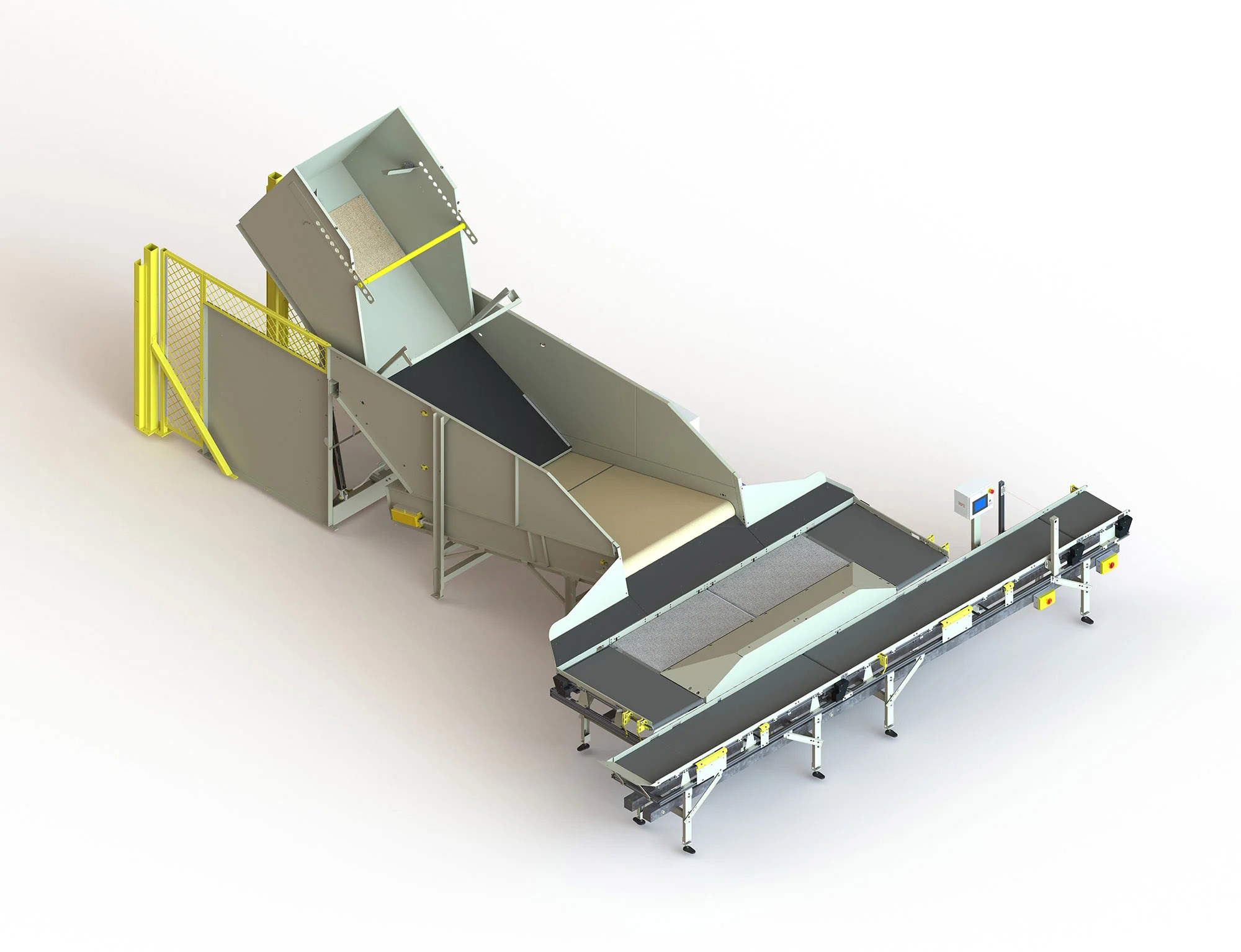
Singulation — turning a pile of mixed parcels into a single, evenly spaced, orientation-controlled line — is the gatekeeper of every sortation system. A sorter is only as fast as the stream feeding it. For years operators faced a binary choice: pay a large manual team to pick and space parcels by hand, or buy a massive fully automated singulation cell with a warehouse-aisle footprint and a matching price tag.
In 2026 that binary is breaking: a persistent labor shortage, sharper capex scrutiny of slow-payback cells, and surge-driven volume volatility that no always-on automated line can justify. The WDA-BS-7000 was engineered exactly for this gap.
The WDA-BS-7000 is built around a high-speed linear narrow-belt deck and a patented singulation mechanism that spreads, aligns, and spaces mixed parcels downstream. It sits at the front end of a sortation line, feeding cross-belt sorters, swivel-wheel sorters, or DWS (Dimensioning, Weighing, Scanning) stations with a clean single-file stream.
Because it is semi-automated, the system is operator-assistive rather than operator-free. One or two workers load bulk parcels onto the infeed; the machine handles the hard part — decoupling, spacing, and presenting each parcel in a controlled orientation. Humans stay where they add the most value; the equipment does the relentless spacing work.
| Parameter | Specification |
|---|---|
| Model | WDA-BS-7000 Semi-Automated Bulk Singulator |
| Max throughput | Up to 7,000 PPH (parcels per hour) |
| Required operators | 1–2 (scales with work flow) |
| Feeding options | Single-lane or dual-lane feeding |
| Parcel compatibility | Polybags, cartons, envelopes, soft packs |
| Conveyance | High-speed linear narrow-belt |
| Control interface | Touch-screen HMI, intuitive operation |
| Operation modes | Multiple modes for different product mixes |
| Footprint | Compact, space-saving design |
| Core technology | Patented singulation mechanism |
Warehouses run highly variable parcel mixes. The WDA-BS-7000 absorbs the bulk infeed and feeds pick-and-pack or sortation lines with a controlled stream, smoothing the peaks that otherwise stall the operation.
3PLs serve many clients with different parcel profiles, and cross-border flows are surge-heavy and inspection-driven. A semi-automated singulator that tolerates mix-and-match — and that an operator reconfigures by touch-screen — is far more practical than a rigid fully automated system, while the dual-lane feeding lets teams scale handling around clearance batches.
Returns are the messiest stream of all — every shape, every condition. Manual-heavy, semi-automated singulation is the realistic way to bring them back into a sortable flow, and at the depot level a singulated stream directly improves scan rates and sort accuracy.
The theme of 2026 is "right-sized automation." Operators are moving away from all-or-nothing bets toward modular, semi-automated equipment that delivers fast payback and adapts to change.
Consider a facility manually singulating with a four-person team across two shifts. Replacing part of that effort with a WDA-BS-7000 operated by one or two staff recovers meaningful labor cost while raising and stabilizing throughput. Because it costs a fraction of a fully automated cell, payback is measured in months, and freed labor moves to exception handling and quality control.
The bigger win is often quality: a singulated, well-presented stream improves scan first-read rates and sort accuracy downstream, cutting mis-sorts, customer complaints, and the costly reverse logistics they trigger.
The Semi-Automated Bulk Singulator WDA-BS-7000 captures the spirit of 2026 logistics: pragmatic, flexible, fast-payback automation that meets operations where they are. By converting bulk parcels into a clean singulated stream at up to 7,000 PPH with one or two operators, it removes the most common sortation bottleneck.
Want to see how the WDA-BS-7000 fits your parcel flow? View the full product page or contact our team for a configuration quote tailored to your parcel profile.
Sorter
Wechat QR code
wechat number:Copyright © 2022-2023 Winda, inc. All rights reserved