

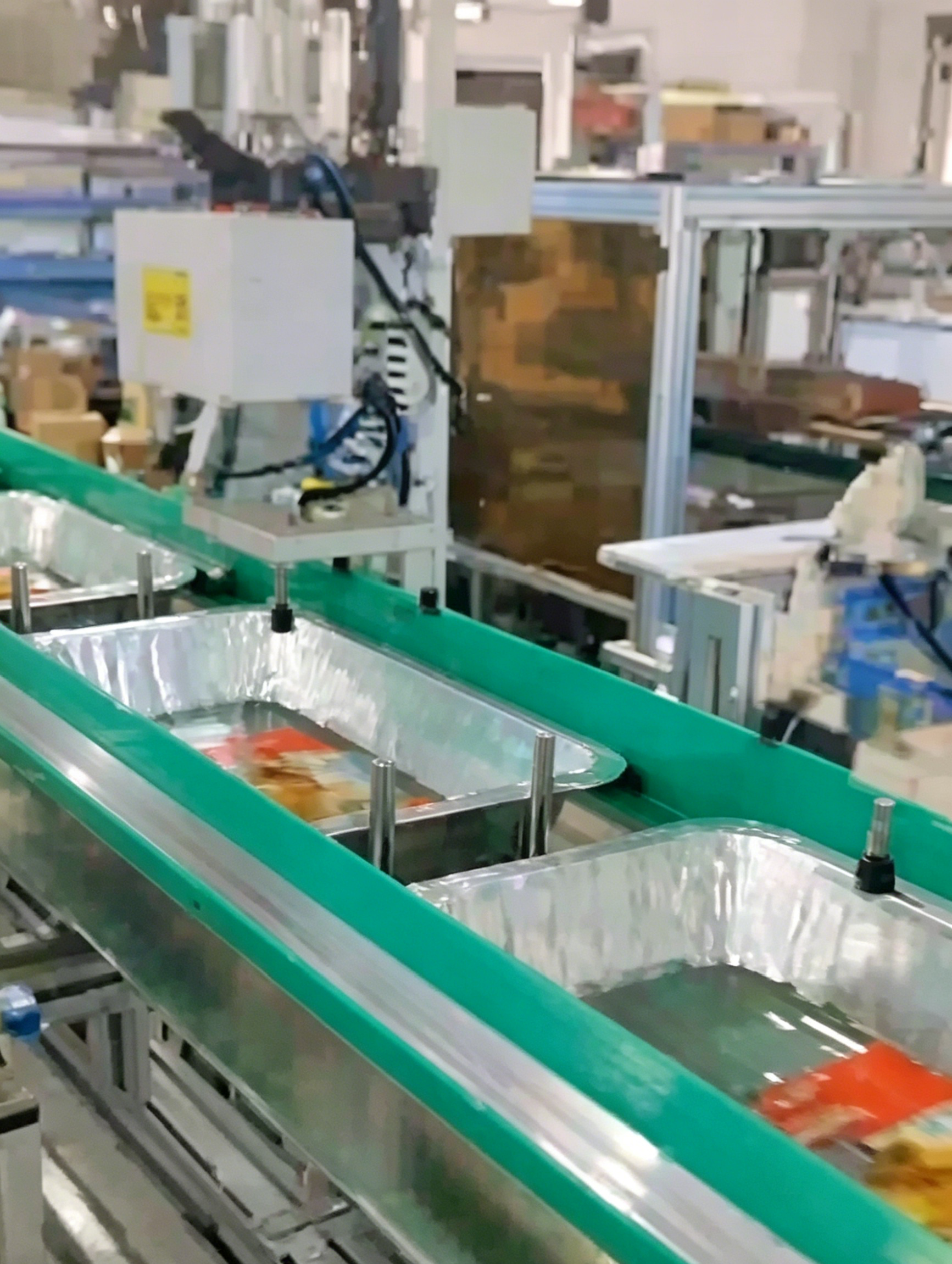
The global food-packaging industry is entering a decisive phase of automation. Driven by the explosive growth of takeout, central kitchens, and plastic-recycling mandates, manufacturers can no longer rely on manual sorting of lunch boxes, picnic containers, baking trays, and plastic lids. At the center of this shift stands a class of equipment that few outside the sector talked about five years ago: the Labeling & Sorting Machine for Baking Tray. In 2026, this intelligent sorting system has evolved from a niche helper into a core pillar of compliant, high-throughput food-packaging production lines.
The Labeling & Sorting Machine for Baking Tray is an automated sorting system specifically engineered for disposable picnic boxes, takeout containers, plastic lids, baking trays, and similar food-packaging products. It integrates high-speed conveying, AI visual recognition, weight detection, and intelligent diverting modules, enabling precise classification by size, material, weight, or order information. By eliminating manual sorting, the line achieves standardized, high-efficiency operation across lunch-box manufacturing, plastic recycling, central kitchens, and food-distribution industries.
Three forces converged in 2026 to make intelligent packaging sorting unavoidable. First, persistent labor shortages and rising wages pushed unit labor costs past the break-even point of automation. Second, tighter food-safety and hygiene regulations rewarded closed, easy-to-clean machine designs. Third, the cost of industrial machine-vision cameras and edge-AI inference dropped by more than 40 percent compared with 2022, making AI sorting affordable for mid-size plants. Together, these trends turned the baking-tray sorting machine from a luxury into a necessity.
| Parameter | Specification |
|---|---|
| Throughput | 9,000 to 18,000 pieces per hour |
| Sorting accuracy | Greater than or equal to 99.9 percent |
| Conveyor speed | 0.8 to 1.2 meters per second (adjustable) |
| Compatible product size | 50 x 50 mm to 500 x 500 mm |
| Changeover time | Approximately 3 minutes between products |
| Recognition method | AI visual recognition plus weight detection |
| Diversion | Multi-lane green belt conveyor, customizable outlets |
| Control system | PLC plus touchscreen HMI with fault warning |
| Material | Food-grade, corrosion-resistant, easy-to-clean |
| Productivity gain | Over 300 percent versus manual sorting |
High Precision Sorting. AI visual recognition combined with high-speed sensors supports multi-dimensional sorting by size, color, material, and weight, with accuracy of at least 99.9 percent.
High Throughput Capacity. The machine handles 9,000 to 18,000 pieces per hour, with an adjustable conveyor speed of 0.8 to 1.2 meters per second to meet mass-production demand.
Flexible Compatibility. It adapts to lunch boxes and picnic containers from 50 x 50 mm up to 500 x 500 mm, and changeover between different products takes only three minutes.
Multi-Lane Diversion. Multi-channel green belt conveyors support customized outlet layouts for multi-category sorting, separating qualified products from impurities and defects.
Food-Grade and Durable. Corrosion-resistant, easy-to-clean materials comply with hygiene standards. Core components such as the PLC and sensors ensure low failure rates and long service life.
Smart Control System. A PLC plus touchscreen interface enables parameter adjustment, real-time data statistics, and fault warning for easy operation and maintenance.
| Application Scenario | Core Value |
|---|---|
| Lunch box and picnic container manufacturing | Removes manual bottleneck; stabilizes output and quality |
| Plastic recycling (lids, containers) | Separates materials by type for higher recycle purity |
| Central kitchens | Meets hygiene standards with closed, cleanable design |
| Food distribution and takeout packaging | Sorts by order information for fast, accurate fulfillment |
| Baking tray sorting | Handles mixed sizes and defects with customizable rules |
Surge in Food-Delivery Volume. The continued expansion of online food delivery and ready-meal services has multiplied the volume of disposable packaging that must be inspected, labeled, and sorted. Plants that once tolerated manual sorting now face order backlogs without automation.
Labor Shortage Accelerates Adoption. Across manufacturing regions, the available workforce for repetitive packing-line tasks is shrinking. Intelligent sorting machines offset this gap, allowing one operator to supervise several lanes instead of staffing a manual team.
Regulatory Pressure on Hygiene. Food-safety authorities are raising requirements for traceability and cleanliness. Closed, easy-to-clean machine architectures that comply with food-grade standards are becoming a procurement prerequisite rather than a differentiator.
Falling Cost of Machine Vision. Edge-AI inference and industrial cameras reached price points in 2026 that put vision-based sorting within reach of mid-size factories, previously the domain of large enterprises only.
Circular-Economy Mandates. Plastic-recycling regulations in multiple markets require higher material purity. Sorting machines that classify by material and color directly support compliance and improve the economics of recycling streams.
Integration With Smart Factories. Modern lines no longer operate in isolation. The PLC and touchscreen control system feeds production data into plant-level dashboards, aligning the baking-tray sorting machine with broader Industry 4.0 initiatives.
Looking beyond 2026, the trajectory is clear: food-packaging sorting will become fully data-driven, with self-learning vision models that adapt to new container shapes without reprogramming, and tighter coupling between sorting, labeling, and upstream molding equipment. For manufacturers evaluating capital investment this year, the Labeling & Sorting Machine for Baking Tray represents not just a productivity upgrade but a strategic hedge against labor volatility, regulatory change, and rising quality expectations.
As the industry matures, the differentiator will shift from raw throughput to intelligence: how accurately the system learns, how quickly it changes over, and how seamlessly it reports. Equipment that closes that loop today is the equipment that will still be competitive in 2030.
Sorter
Wechat QR code
wechat number:Copyright © 2022-2023 Winda, inc. All rights reserved