

Global parcel volumes continue to climb, and the warehouses, fulfillment centers, and express transfer hubs that move them are under relentless pressure to ship faster with fewer people. At the front end of every automated sorting line sits a deceptively difficult task: turning a chaotic pile of mixed, overlapping parcels into a clean single-file stream. The technology that solves this is the single-piece logistics separation system, and in 2026 it is being transformed by AI vision, smarter control algorithms, and a wider push toward fully unmanned operations.
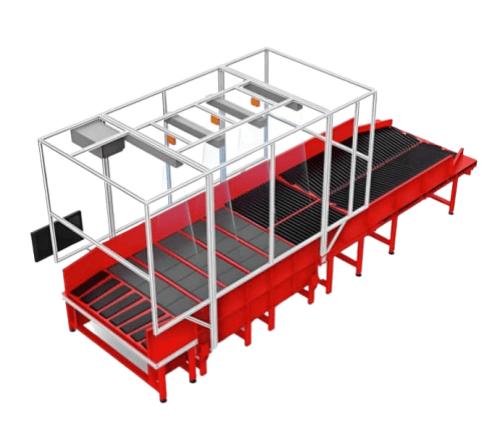
In this article we look at how AI vision-based single-piece logistics separation systems work, the technical capabilities that matter in 2026, where they are being deployed, and the broader market forces reshaping parcel singulation this year.
A single-piece logistics separation system is an intelligent automated solution designed to handle one of the most challenging tasks in modern logistics: converting mixed, overlapping parcels into a single-file stream for downstream sorting equipment. Rather than relying on mechanical dividers or manual labor, the latest systems use a binocular industrial camera to capture a real-time 3D model of every parcel on the infeed belt, then calculate the optimal trajectory to nudge each item apart and center it for the next station.
The result is a critical front-end foundation for building fully unmanned sorting lines in e-commerce fulfillment centers, express transfer hubs, and distribution facilities worldwide. When separation succeeds at scale, everything downstream - cross-belt sorters, narrow-belt sorters, swivel wheel sorters, and robotic arms - runs at peak efficiency.
| Parameter | Specification |
|---|---|
| Product Type | Single-Piece Logistics Separation System (AI Vision Parcel Singulation) |
| Vision System | Dual-camera (binocular) industrial 3D vision |
| Separation Accuracy | >= 99% separation success rate |
| Belt Speed | Adjustable 1.2 - 2.2 m/s dynamic control |
| Data Protocol | TCP/IP, reliable TCP protocol-based real-time communication |
| Control Module | Hard-trigger line linkage with dynamic speed adjustment |
| Auto-Centering | Automatic package centering on conveyor during separation |
| Robustness | Unaffected by package overlap or disorganized input streams |
| Certifications | CE & ISO9001 certified |
| Manufacturer | WINDA Intelligent Equipment Co., Ltd. (Shenzhen, China) |
The dual-camera industrial vision system performs real-time 3D modeling of parcels, capturing position, contour, dimensions, and surface reflectivity features. This rich data set allows the controller to distinguish touching parcels that a single 2D camera would read as one blob, which is the core reason separation accuracy holds at 99% or higher even in cluttered conditions.
A hard-trigger line linkage control module enables dynamic speed adjustment from 1.2 to 2.2 m/s, achieving rapid singulation while maintaining gentle package handling. Speed scales with incoming density, so the system slows down for jammed infeeds and accelerates when the belt is clear.
Advanced divergence models and separation algorithms calculate optimal parcel movement trajectories, ensuring a >=99% separation success rate regardless of initial clutter conditions. Trajectory planning runs on every frame, which is what lets the machine handle high-mix, multi-SKU e-commerce parcels of wildly different shapes and sizes.
The system automatically centers packages on the conveyor during separation, ensuring consistent positioning for downstream sorting equipment and improving overall sort accuracy. Consistent centering is what makes high-speed cross-belt and narrow-belt sorters reliable at the back end.
TCP protocol-based data communication ensures real-time transmission between the vision system and the control module with minimal latency and high reliability. Low-latency links matter because trajectory corrections have to land before a parcel reaches the next physical station.
System performance remains unaffected by package overlap or disorganized input streams, making it ideal for high-mix, multi-SKU e-commerce environments where orderly infeeds are the exception rather than the rule.
The single-piece logistics separation system is deployed wherever mixed parcels must be reorganized into a single stream before they can be processed:
In 2026, the cost of industrial 3D cameras and edge inference has fallen far enough that binocular vision is no longer reserved for flagship sorting centers. Mid-size operators can now deploy singulation systems that previously only national postal networks could afford. This is expanding the total addressable market well beyond tier-one e-commerce players.
Hardware is becoming a commodity while the value shifts to the divergence algorithms. Vendors that ship over-the-air model updates, adaptive trajectory planning, and site-specific tuning are pulling ahead. The ability to retrain a separation model on a customer's actual parcel mix - without touching the mechanical line - is emerging as the key differentiator this year.
Persistent shortages of warehouse labor are forcing operators to remove people from the infeed entirely. Single-piece separation is the unglamorous but essential step that makes a "lights-out" sorting line possible, and demand is being pulled by real operational pain rather than by hype.
Supply chains in 2026 are built for volatility. Facilities must absorb parcels from many origins, in many shapes, with little notice. Clutter-immune separation systems that hold 99%+ accuracy under disorganized input are becoming a resilience requirement, not a luxury.
Energy efficiency and gentle handling are moving up the priority list. Dynamic speed control that slows the belt only when necessary, combined with precise singulation that reduces jams and rework, directly lowers energy use and damage rates - two metrics that procurement teams now track.
Singulation is no longer a standalone island. Real-time TCP/IP links let the separation system share parcel dimensions and position with downstream sorters, robotics, and warehouse management systems, turning a mechanical front end into a data-rich node in a connected, software-defined facility.
The single-piece logistics separation system has quietly become one of the most important enabling technologies for modern automated logistics. As 2026 progresses, the winners will be systems that combine robust binocular 3D vision, adaptive divergence algorithms, and open real-time communication - exactly the capabilities built into WINDA's AI vision-based parcel singulation platform. For operators planning new or upgraded sorting lines this year, getting singulation right at the front end is the single highest-leverage decision they can make.
WINDA Intelligent Equipment Co., Ltd. designs and manufactures CE and ISO9001 certified single-piece logistics separation systems for e-commerce, express, retail, aviation, medical, and 3PL operations worldwide. Contact our team for a customized quotation tailored to your facility's throughput requirements and parcel characteristics.
Sorter
Wechat QR code
wechat number:Copyright © 2022-2023 Winda, inc. All rights reserved