

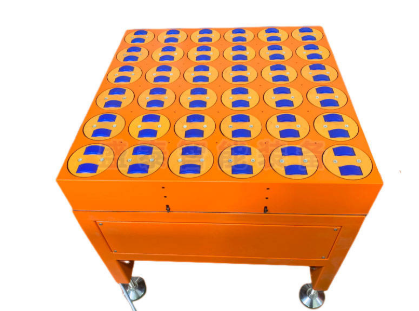
Figure 1: Modular rotary wheel sorting unit with integrated servo drive and PLC control.
Distribution centers across the globe are entering a new phase in 2026. Driven by record e-commerce volumes, labour shortages, and rising pressure to cut cost-per-parcel, operators are demanding sorting systems that combine throughput, accuracy, and flexibility without forcing a complete redesign every time volumes shift. The Modular Rotary Wheel Sorting Unit from WINDA Co., Limited has been engineered precisely for this reality, offering a plug-and-play architecture that scales from a small 4-outlet starter cell to a 24+ outlet production line, all powered by high-precision servo motors and an IoT-ready control platform.
Legacy sorting modules built on fixed-angle belts, pop-up wheels, or chain diverters served the logistics industry well for decades, but the assumptions of that era no longer hold. Today’s fulfilment environment is defined by SKU explosion, shorter delivery windows, and operational churn driven by promotional peaks and omnichannel returns.
| Legacy Limitation | Real-World 2026 Impact |
|---|---|
| Rigid sorting geometry | Cannot adapt to new SKUs, oversized parcels, or layout changes |
| Complex integration | Weeks of PLC mapping for every new WMS / WCS upgrade |
| Frequent belt swaps | Unplanned downtime during peak season |
| Fixed-speed drive | 30-40% wasted energy during low-load windows |
| No remote diagnostics | Engineers must be on-site to triage faults |
These pain points have turned modular architecture from a "nice to have" into a hard procurement requirement. According to industry analyst briefings published in Q1 2026, more than 65% of new sortation projects in EMEA and APAC now specify modular cells that can be expanded, reconfigured, or relocated without replacing the entire line.
The Modular Rotary Wheel Sorting Unit is a premium intelligent sorting module that integrates servo drive, intelligent control, and high-precision recognition technologies. As the core building block for constructing modern logistics sorting lines, it is ideally suited to e-commerce logistics, express warehousing, and industrial storage applications where throughput, accuracy, and layout flexibility must coexist.
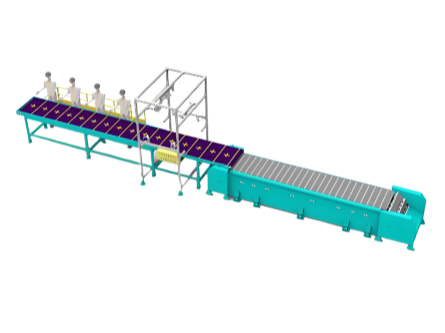 At the heart of each unit is a high-precision servo motor driving the rotary wheel mechanism through a variable-frequency drive. This pairing delivers smooth acceleration profiles, accurate positioning at every outlet, and quiet operation even when running at full rated throughput. The unit handles parcels from 50x50x10mm up to 600x500x400mm, covering the vast majority of B2C, B2B, and reverse-logistics parcels encountered in 2026.
Each module sorts up to 8,000 items per hour while maintaining an accuracy of 99.9% or better. Multiple modules can be linked in series or parallel to compose a multi-station line capable of 30,000+ PPH without redesign of upstream conveyors. Combined with a DWS (dimension, weight, scan) station, the line achieves end-to-end scan-to-diverter latency under 1.2 seconds.
The unit ships as a plug-and-play assembly: bolted-down frame, pre-wired harness, and a standardised service port. Operators can install a single cell, commission it within hours, and add new outlets as volumes grow. The modular approach also simplifies spare-parts stocking — one set of consumables fits every deployed cell.
Onboard PLC connectivity over TCP/IP, Modbus RTU/TCP, or optional Profinet makes integration straightforward. Native 4G/5G/WiFi/Ethernet IoT support streams temperature, vibration, motor current, and cycle counts to a remote dashboard, enabling predictive maintenance: anomalies such as rising belt friction or motor torque spikes are flagged before they trigger downtime.
Three macro trends are reshaping warehouse automation in 2026, and each one directly favours modular rotary wheel architecture.
Returns volumes in 2026 have grown to roughly 17-20% of e-commerce orders in major markets. Returns are inherently irregular in shape and weight, so a sorter that handles 50mm-600mm parcels without manual re-routing is operationally priceless. The rotary wheel’s variable-speed servo adjusts instantly when a heavier or oddly-shaped parcel enters the cell, eliminating the jams common on fixed-speed belt sorters.
Energy remains a top-three operating expense for distribution centres. Compared with fixed-speed belt sorters, the variable-frequency servo drive in the modular unit cuts energy consumption by 30-40%, and the savings compound at scale across 24/6 operations.
Rather than eliminating workers, leading operators are redeploying staff to higher-value exception handling. The IoT dashboard lets a small central team supervise dozens of cells across multiple sites, responding remotely when the predictive-maintenance system surfaces an alert.
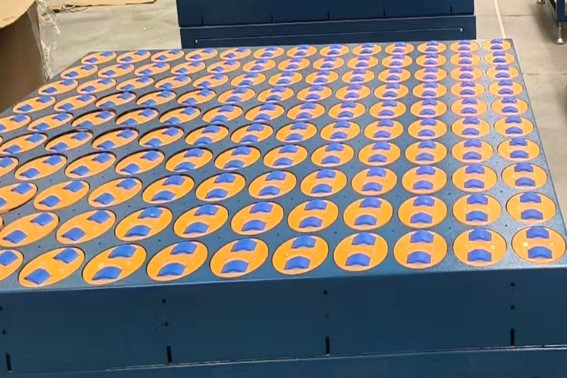 The modular rotary wheel sorting unit fits a wide range of operational profiles.
| Application | Typical Configuration | Value Delivered |
|---|---|---|
| E-commerce fulfilment | 8-16 outlets per line, DWS upstream | Flexible peak-season expansion, reduced labour |
| Postal & express hubs | 12-24 outlets, integrated with X-ray / volumetric | Improved transit time, lower cost per parcel |
| Industrial warehousing | 4-8 outlets matched to production lines | Just-in-time material flow, smaller WIP buffer |
| Specialised sectors | Books, medical supplies, cosmetics | Targeted sortation, gentle handling |
Software integration. The unit ships with WMS / WCS integration over standard APIs and supports major platforms including SAP EWM, Manhattan Active WM, and Blue Yonder. Project teams configure mapping rules, not custom code.
Hardware compatibility. Compatible with all major conveyor types: belt, roller, chain, and pop-up wheel systems. Existing lines can adopt the modular cell as a drop-in upgrade.
Custom configurations. Outlet angles, speeds, and layouts can be tailored to match facility constraints such as low ceilings, mezzanine floors, or odd-shaped docks.
Scalability. Add modules as the business grows — no need to replace the entire system.
Standard configurations ship within 4-6 weeks. Custom integrations may require 8-12 weeks depending on complexity. Ready-to-ship inventory is maintained for common configurations to minimise lead times.
Yes. The modular design allows outlet positions and angles to be reconfigured without replacing the entire unit, ideal for facilities with evolving operational needs.
Routine maintenance is light: quarterly lubrication (about 15 minutes per unit), annual belt-tension check, and remote firmware updates. Predictive-maintenance alerts flag issues before they become downtime.
The variable-frequency servo drive reduces energy consumption by 30-40% compared with fixed-speed belt sorters. The system automatically adjusts power based on actual parcel flow, eliminating waste during low-volume windows.
A 2-year standard warranty covers all hardware components, with a 5-year warranty on the servo drive system. The global support team offers 24/7 remote diagnostics and on-site service within 48 hours in major markets.
Industry briefings through Q2 2026 indicate that modular sorter cells will become the default architecture for greenfield distribution centres and for retrofit upgrades of legacy lines. The combination of scalability, energy efficiency, IoT-driven maintenance, and broad SKU compatibility makes the modular rotary wheel unit a building block that pays back across multiple business cycles rather than a single capex event.
For operators planning capacity expansion, evaluating peak-season flexibility, or targeting measurable energy savings in 2026, the modular rotary wheel sorting unit offers a practical, future-proof foundation.
Contact WINDA’s engineering team for a customised solution designed to your specific throughput, layout, and integration requirements.
Sorter
Wechat QR code
wechat number:Copyright © 2022-2023 Winda, inc. All rights reserved