

The warehouse and parcel landscape of 2026 looks nothing like it did five years ago. Order volumes keep climbing, SKU counts explode, and tolerance for mis-sorts has shrunk to near zero. At the center of this shift sits a deceptively simple mechanism: the swivel wheel sorter. WINDA's high-efficiency systems, rated at up to 20,000 pieces per hour with 99.9%+ accuracy, have become a backbone for fulfillment centers, postal hubs, and manufacturing lines that must move goods as fast as data flows.

This article examines how swivel wheel sortation is evolving in 2026, where it is deployed, and what market forces are pushing adoption to record levels. We also benchmark it against tilt-tray and cross-belt alternatives so operations leaders can make evidence-based capital decisions.
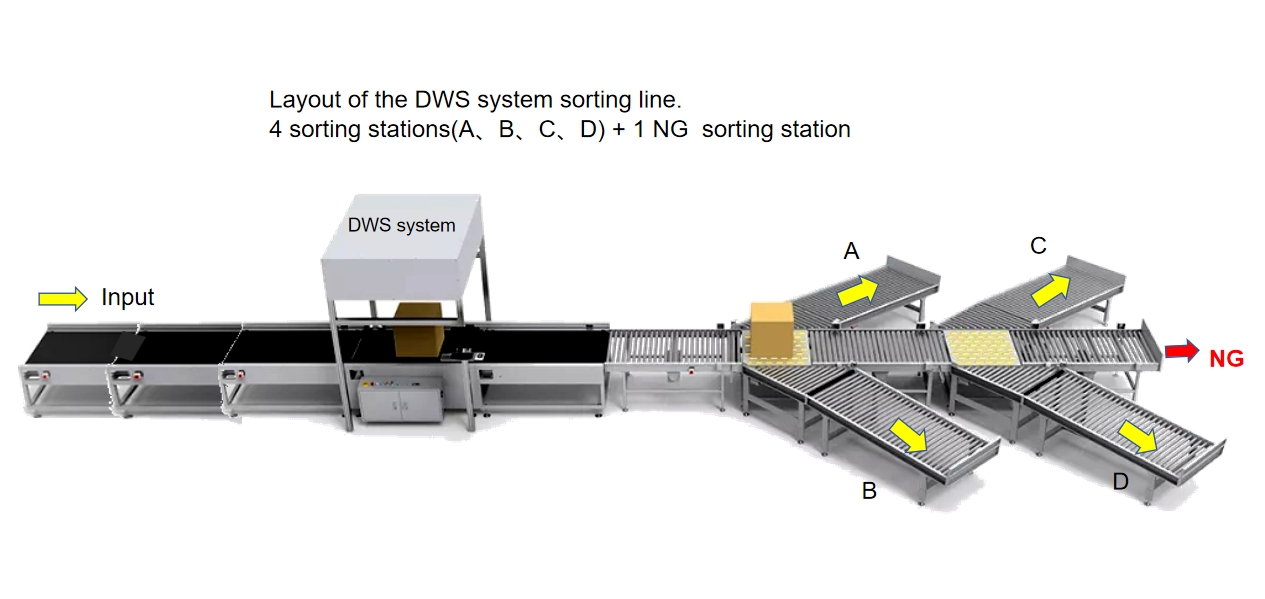
A swivel wheel sorter is a high-speed diverter built into a belt or roller conveyor line. At each decision point, a row of small omni-directional wheels rotates to a precise angle and deflects items sideways into the correct outlet. Because the wheels spin rather than push, items are guided gently and at speed, with minimal impact, noise, or jam risk.
The WINDA configuration supports 6 to 40+ outlets, a speed of 0.5 to 2.5 m/s, and items from 100 x 100 mm to 600 x 600 mm weighing 10 g to 30 kg. Recognition is handled by barcode, QR code, OCR, or optional RFID, triggering each wheel array at the precise arrival moment.

| Sorting Capacity | Up to 20,000 pieces/hour |
|---|---|
| Item Size Range | 100 x 100 mm to 600 x 600 mm |
| Item Weight Range | 10 g - 30 kg |
| Sorting Accuracy | 99.9%+ |
| Number of Outlets | Configurable 6 - 40+ outlets |
| Conveyor Speed | 0.5 - 2.5 m/s adjustable |
| Recognition Technology | Barcode, QR Code, OCR, RFID optional |
| Power Supply | 380V / 50Hz or custom voltage |
In 2026, recognition is no longer just a fixed barcode scan. Embedded AI vision models classify deformed labels, damaged cartons, and mixed-size items in real time, compensating for poor print contrast and skewed placement. This lifted effective read rates and shaved mis-sort incidents, contributing to the 99.9%+ accuracy now expected as a baseline.
Wheel arrays, motors, and encoders now ship with vibration and temperature telemetry streamed to a cloud dashboard. Instead of reacting to a breakdown, teams replace a worn bearing during a planned window. For a system running 20,000 cycles per hour, this capability can mean the difference between 99% uptime and an unplanned multi-day stoppage.
Before a single steel frame is bolted, 2026 integrators build a digital twin of the sortation line. Throughput simulations validate outlet counts, buffer lengths, and merge geometry against real order-wave profiles, eliminating the over- or under-sizing that plagued earlier generations.
Routing logic is decoupled from hardware. A software layer lets managers re-map outlets, prioritize expedited orders, or isolate a faulty chute without touching the physical line, matching the volatility of modern omnichannel demand.

When specifying a high-speed sorter, three technologies compete for the same floor space. The table below summarizes the trade-offs operators weigh in 2026.
| Feature | Swivel Wheel | Tilt Tray | Cross Belt |
|---|---|---|---|
| Gentle Handling | Excellent | Good | Moderate |
| Maintenance Cost | Low | Medium | Higher |
| Footprint | Compact | Large | Very Large |
| Noise Level | Quiet (<70 dB) | Moderate | Louder |
| Initial Investment | Lower | Higher | Highest |
For most mid-volume to high-volume operations, the swivel wheel design wins on footprint, noise, and lifetime cost, while delivering accuracy on par with more expensive alternatives.
The numbers tell a consistent story. A swivel wheel line replaces a manual sort crew, cuts error-driven returns, and absorbs seasonal peaks without temporary labor. When evaluating options, factor the full lifecycle: the swivel wheel's low maintenance cost and compact footprint reduce both opex and the building's square-meter cost.
Operations that pair the sorter with adjacent automation, such as a high-speed narrow-belt sorter for primary induction or a linear narrow-belt sorting machine for secondary sort, unlock end-to-end flow with minimal human touch.
In 2026, the swivel wheel sorter is no longer an exotic option reserved for mega-hubs. Its blend of speed, gentleness, quiet operation, and low lifetime cost makes it the pragmatic default for any operation moving thousands of items per hour. As AI vision, IoT telemetry, and software-defined routing mature, the technology keeps pushing the accuracy and uptime envelope, turning sortation from a bottleneck into a competitive advantage.
Published 2026-10-19 by WINDA Sorting Systems. Explore the full product range or contact our engineering team for a tailored throughput simulation.
Sorter
Wechat QR code
wechat number:Copyright © 2022-2023 Winda, inc. All rights reserved