

As parcel volumes keep climbing and same-day delivery becomes the norm, the circular cross-belt sorter has moved from a niche investment to the backbone of modern distribution centers. WINDA's circular cross-belt sorter reaches a theoretical throughput of 40,000 pieces per hour with verified real-world output of 21,600 pieces per hour and a sorting accuracy above 99.99%. This article reviews the technology trends shaping cross-belt sorting in 2026, where the market is heading, and how operators can evaluate the return on investment.

A circular (loop) cross-belt sorter is a closed-loop conveyor system in which a chain of independently powered trolleys, each carrying a short belt mounted crosswise, circulates continuously around an oval track. As each trolley passes an induct station, an item is scanned and weighed; when the trolley reaches the destination chute, the cross-belt runs and gently drops the item into the chute. Because trolleys never stop, the system delivers continuous flow with minimal vibration and exceptional handling care.
| Parameter | Specification |
|---|---|
| Theoretical Throughput | 40,000 pcs/hour |
| Actual Throughput (verified) | 21,600 pcs/hour |
| Sorting Accuracy | >99.99% |
| Cargo Loss Rate | <0.01% |
| Noise Level | <65 dB (indoor compliant) |
| Infeed Design | Dual-zone, 12-person collaborative supply |
| Grid Width (Large Item) | Prioritized >750 mm expansion |
| Trolley Drive | Independent belt control per trolley |
| DWS Integration | Automatic scanning + weighing + dimensioning |
| Custom Options | Grid count, lane height, trolley quantity configurable |
In 2026, the biggest leap in cross-belt sorting is intelligence at the induct point. Modern systems pair high-resolution line-scan cameras with deep-learning OCR engines that read smudged, partially covered, or reprinted labels that legacy laser scanners reject. When a barcode is unreadable, AI vision infers the destination from address fragments, sender history, and parcel geometry, cutting manual re-induction labor dramatically. Routing engines now retrain themselves continuously: as chute exceptions accumulate, the system rebalances destination assignments in real time to keep every lane productive.
Each trolley in a circular sorter is now a sensor node. Vibration, temperature, and motor-current data stream from every drive unit to the cloud, where analytics models flag a bearing weeks before it fails. Operators report that predictive maintenance converts unplanned line stops into scheduled part swaps during off-shifts. In 2026 fleets, the mean time between unplanned stoppages has stretched from days to months, protecting the peak-season revenue that depends on every operating hour.
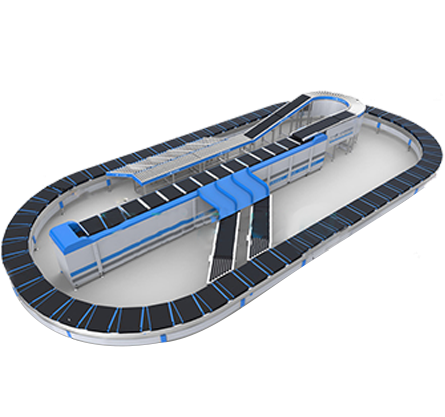
Dimensioning-weighing-scanning (DWS) has merged with induction. The dual-zone infeed of WINDA's circular sorter lets twelve operators feed parcels collaboratively while cameras capture length, width, height, weight, and images in a single pass. This one-shot data capture serves three masters at once: sorting decisions, freight-audit billing, and traceability archives. For e-commerce sellers, accurate dim-weight data captured at induction directly reduces carrier chargeback disputes.
Facilities change, and 2026 sorters are built to change with them. Grid count, lane height, and trolley quantity are configurable, and expanding grid width beyond 750 mm for large-item lanes is a prioritized option. Because each trolley carries an independent belt drive, the track can be extended or re-purposed by adding trolley modules rather than rebuilding the loop. Software-defined chutes let one physical lane serve different destinations by hour of day, multiplying effective capacity without adding steel.
A noise level below 65 dB keeps the sorting hall within indoor workplace limits, an increasingly regulated metric in Europe and East Asia. Combined with electric trolley drives that coast between chutes, energy per parcel keeps falling, and warehouses report a calmer, safer floor where voice communication remains possible near the line.
| Sector | Typical Use Case |
|---|---|
| E-commerce fulfillment | Order-to-carrier allocation for 21,600+ parcels per hour during promotions |
| Postal and express | National hub sorting of mixed flat, parcel, and polybag mail |
| Apparel and retail | Soft-goods returns processing with gentle belt discharge |
| Pharmaceuticals | Low-vibration handling for blister packs and boxed medicine |
| Third-party logistics | Multi-tenant routing with software-switched chutes |
The verified cargo loss rate below 0.01% is the decisive metric for apparel and pharmacy shippers, where a damaged item costs far more than the transport fee. The closed-loop design also suits mid-size city hubs that cannot afford the footprint of a linear bomb-bay sorter.
Industry analyses consistently place the global sorting-automation market on a mid-single-digit to high-single-digit annual growth path through 2030, with cross-belt technology taking share from pop-up and shoe sorters in the parcel segment. Three forces drive the trend: labor scarcity in major logistics markets, e-commerce volumes that no longer shrink back after each promotion peak, and falling per-trolley electronics costs that make large loops affordable for regional players, not only national carriers. In 2026, buyers increasingly specify trolley-level telemetry and open API integration with warehouse management systems as standard requirements rather than options.
For a regional e-commerce hub processing roughly 150,000 parcels daily, moving from manual sorting to a circular cross-belt sorter typically cuts sorting labor per shift by more than half while raising same-day dispatch cut-off capacity. Accuracy above 99.99% eliminates the compounding cost of mis-sorts: redelivery fees, customer-service contacts, and penalty SLAs. Most operators model payback in two to four years, with peak-season labor avoidance as the largest single saving.
The circular cross-belt sorter in 2026 is no longer just a mechanical workhorse. With AI vision reading the labels humans cannot, trolley-level IoT keeping the loop running, and DWS capturing billable data at induction, it has become the data-rich core of the modern warehouse. Companies planning capacity for the next promotion peak should evaluate verified throughput, expandability, and telemetry openness when shortlisting systems.
Sorter
Wechat QR code
wechat number:Copyright © 2022-2023 Winda, inc. All rights reserved