

The Belt Turning Machine (Belt Curve Conveyor) from WINDA is one of the quiet workhorses of a modern production or distribution floor. Instead of forcing a facility into a straight-line layout, a curve conveyor lets packages, cartons and totes change direction by 30, 45, 90 or 180 degrees without manual transfer. As we move through 2026, these units are evolving from passive geometry into sensor-rich, software-connected nodes. This outlook reviews the verified specification and the 2026 technology trends shaping belt turning machines this year.
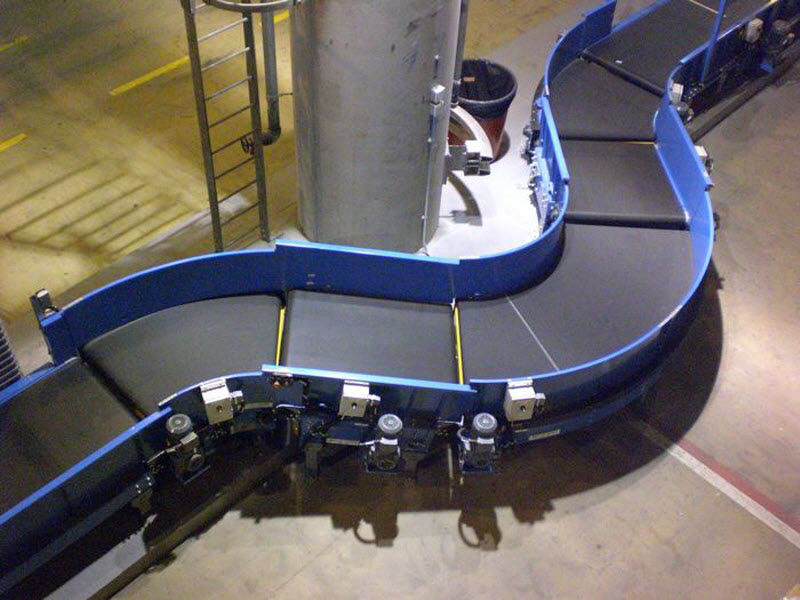
A belt curve conveyor keeps items moving on a continuous belt while the path bends. Because the belt follows a precise radius, products stay oriented and stable through the turn, which is why curve conveyors are preferred over powered roller bends for cartons, bags and unstable loads. The verified specification of the WINDA belt turning machine is summarized below.
| Parameter | Specification |
|---|---|
| Product | Belt Turning Machine - Belt Curve Conveyor (WINDA) |
| Turning Angle | 30 deg / 45 deg / 90 deg / 180 deg (custom angles available) |
| Conveying Speed | 0.1 - 1 m/s (variable frequency speed regulation) |
| Standard Belt Width | 500 mm / 800 mm / 1000 mm / 1200 mm / 1400 mm |
| Inner Turning Radius | 1270 mm - 2200 mm (optional) |
| Motor Power | 0.75 kW - 2.2 kW |
| Frame Material | Carbon steel with plastic spray (standard) / 304 stainless steel (optional) |
| Belt Material | PVC (standard) / PU / anti-static / food-grade (optional) |
| Operation Mode | Continuous / intermittent, single or multi-layer structure |
Because belt width, radius and angle are modular, a single platform serves a small workshop and a large fulfilment center by changing the configuration. The 304 stainless steel and food-grade belt options also make the same machine valid in both dry logistics and hygienic food lines.
The belt is trained around a curved bed and driven by a motor with variable frequency control. Operators set the line speed between 0.1 and 1 m/s to match the upstream and downstream equipment. Items ride through the bend on the same belt surface, so there is no transfer gap that could catch a carton corner or tip a light parcel.
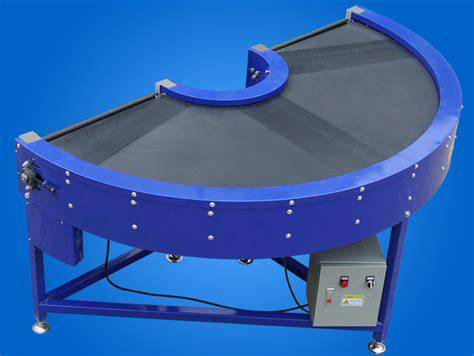
In 2026, curve conveyors are no longer blind. A speed encoder and a load sensor at each bend report belt slip, motor current and jam tendency to a central dashboard. When a section runs hotter or draws more current than its baseline, the system flags maintenance before a full stop. For a line that depends on continuous flow, this shift from reactive repair to predictive care is the biggest change of the year.
The 0.1 to 1 m/s range is now paired with demand-based control. When upstream buffers are empty, the curve section slows or idles instead of running at full speed, cutting power on a 0.75 to 2.2 kW motor across a long shift. Buyers in 2026 weigh energy per transferred item, not just the sticker price.
Standardized belt widths (500 to 1400 mm) and selectable radii (1270 to 2200 mm) let integrators assemble a layout from catalog modules. A 90-degree bend drops into an existing line without custom fabrication, shortening commissioning time and making future re-layouts far cheaper.
The optional 304 stainless steel frame, PU belt and anti-static or food-grade surfaces answer two 2026 demands at once: cleanability for food and pharmaceutical lines, and static control for electronics and packaging films. One machine family now spans both wash and ESD-sensitive environments.
Before steel is cut, engineers rehearse the floor plan in a digital twin, testing where a 30, 45, 90 or 180 degree bend should sit and simulating peak flow, removing the trial-and-error that once plagued conveyor retrofits.
Several forces push curve-conveyor investment upward in 2026:
Analysts expect steady growth in modular conveying through 2026, with smart, sensor-connected curve sections taking share from fixed, unmonitored bends. WINDA positions the belt turning machine as a configurable building block that scales from a single bend to a multi-layer network.
The ROI case in 2026 rests on three pillars: labor saved by removing manual transfer points, damage avoided by stabilizing loads through the turn, and downtime avoided through predictive maintenance on the 0.75 to 2.2 kW drive. Logistics references report that a well-placed 90 degree bend paid for itself within a year by reclaiming floor space.

A belt turning machine is most valuable when combined with complementary WINDA equipment:
Email: info@wdsort.com | WhatsApp: +86 186 2085 0485
Sorter
Wechat QR code
wechat number:Copyright © 2022-2023 Winda, inc. All rights reserved