

The Automated Parcel Sorter - Xstream (WDA-XS-24000) from WINDA has become a benchmark for sorting difficult-to-automate parcels at very high throughput. Capable of processing up to 24,000 parcels per hour with 99.9 percent accuracy, the shoe-and-slat sorter drops each item into tubs, sacks and gaylords by destination. As we move through 2026, AI vision, omni-directional scanning and cloud-connected control are turning this mechanical platform into a software-defined node in the logistics network. This outlook examines the technology trends, applications and market direction shaping automated parcel sorters in 2026.
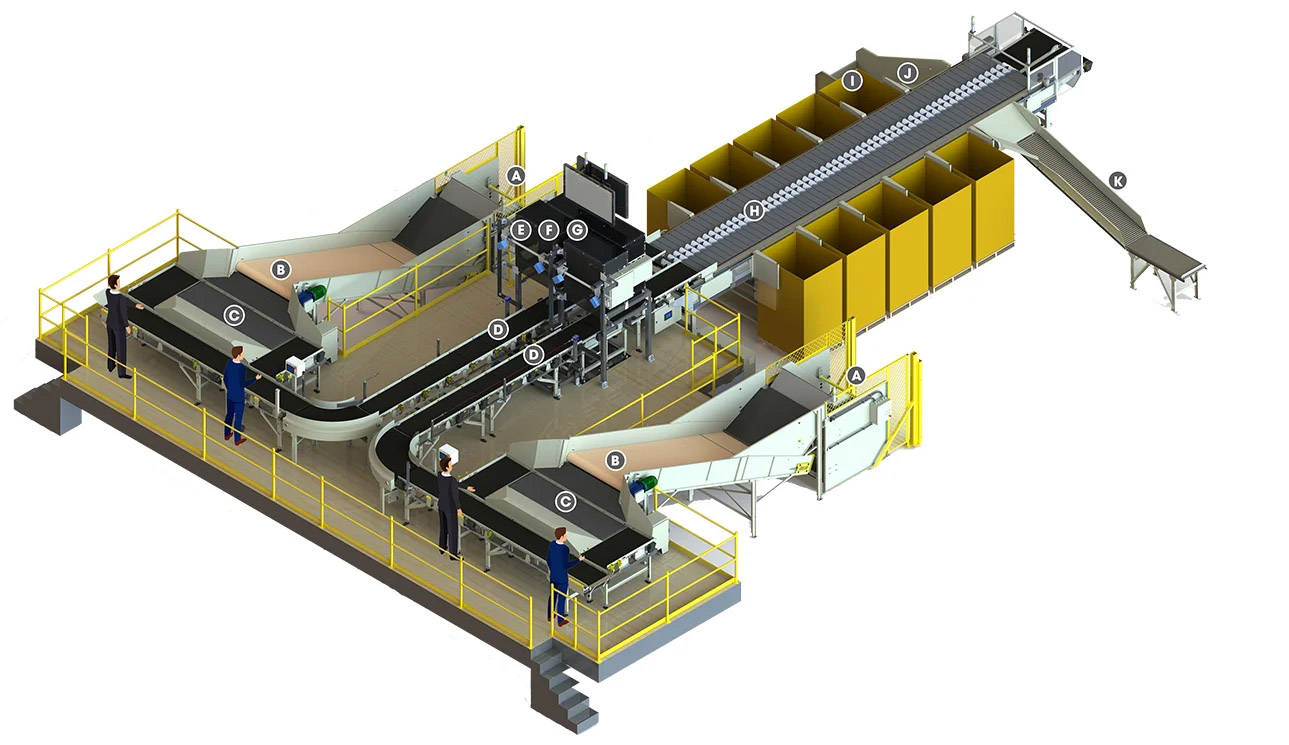
The WINDA Xstream is built for operations that must sort parcels too irregular, soft or mixed for conventional tilt-tray and cross-belt lines. Its shoe-and-slat mechanism is optimized for consistent anti-jam sorting. The verified specification is summarized below.
| Parameter | Specification |
|---|---|
| Model | Automated Parcel Sorter - Xstream WDA-XS-24000 |
| Sorting Capacity | Up to 24,000 parcels and flats per hour |
| Sorting Accuracy | 99.9% |
| Diverter Type | Shoes and slats, anti-jam optimized |
| Scanning | Multi-sided omni-directional (1D, 2D, Postal barcodes) |
| Length Range | 4 in (101 mm) - 24 in (610 mm), greater capacity optional |
| Width Range | 4 in (101 mm) - 20 in (508 mm) |
| Height Range | 0.197 in (5 mm) - 18 in (457 mm) |
| Weight Range | 0.8 oz (23 g) - 60 lbs (27.2 kg) |
The machine handles plastic, poly bags, boxes, flats and most irregular pieces, and it integrates with existing conveyor systems. Because it sorts by destination zip code automatically, a single line replaces many manual stations.
Parcels enter on an induction conveyor and are presented to a multi-sided scanning zone where several cameras read the barcode no matter how the item is oriented. The control system maps the decoded destination to a specific bin or chute and triggers the shoe-and-slat diverter at the precise moment. At 24,000 parcels per hour the decision window per item is a few milliseconds, so recognition speed and mechanical timing must stay tightly synchronized. Each bin destination carries a sensor that notifies operators when it is full and ready to be swapped - the "smart bin management" feature that keeps the line flowing.

Traditional systems relied on a barcode being presented flat to a single scanner. In 2026, on-device AI vision models read damaged, skewed, low-contrast and partially obscured labels, and they reconcile multiple camera views into one confident destination decision. This lifts effective read rates on real-world parcels, where labels are often wrinkled, taped or printed on curved surfaces.
Modern WCS deployments add a feedback loop: when an operator corrects a mis-sort, the system records the correction and adapts routing rules. Over weeks the sorter learns local postal formats, carrier labels and seasonal address patterns, pushing effective accuracy beyond the 99.9 percent mark on unfamiliar batches.
Sensors on motors, belts and diverters stream vibration and temperature to a dashboard. Instead of reacting to a jam, the operator receives a warning days before a belt or encoder is likely to fail. For a 24,000 parcels/hour line, avoiding one unplanned stop protects tens of thousands of correctly sorted items per shift.
A digital twin mirrors the physical line so engineers can rehearse a new bin map before touching hardware. Routing rules become configuration rather than wiring: a peak season needing more destination bins is a software change, not a rebuild.
2026 buyers weigh power per sorted parcel and floor space. Variable-speed drives, standby zoning and a compact modular chassis cut energy during low-volume windows and fit facilities with limited space.
Several forces push parcel-sorting investment upward in 2026:
Analysts tracking warehouse and parcel automation project steady growth through 2026, with smart, software-defined shoe-and-slat sorters taking share from fixed mechanical lines. WINDA positions the WDA-XS-24000 as a scalable entry that grows with the operation.
At 24,000 parcels/hour with 99.9 percent accuracy, a single Xstream line can replace many manual sorting stations. The ROI case in 2026 rests on three pillars: labor saved, error cost avoided, and uptime gained from predictive maintenance. Customer references report payback within months after installation, with one logistics director citing 99.9 percent accuracy and a six-month return.
Parcel sorting is often combined with complementary WINDA equipment:
You can also read our industry outlook on the Card Sorting Machine 2026 Outlook.
Email: info@wdsort.com | WhatsApp: +86 186 2085 0485
Sorter
Wechat QR code
wechat number:Copyright © 2022-2023 Winda, inc. All rights reserved