

A playing card is no longer a disposable consumable. In 2026 it is a security asset in a regulated casino pit, a graded collectible in a trading card market worth more than the press that printed it, and a quality record in a factory shipping decks worldwide. Card sorting has become a measurable compliance function.
The WINDA WDA-PS-2000 is a benchtop, AI-vision card sorter rated at 2,000 cards per hour with above 99.9% recognition accuracy. It does not compete with parcel systems on throughput. It solves the opposite problem: modest volumes of high-value cards that must be verified, counted and audited with no tolerance for error.
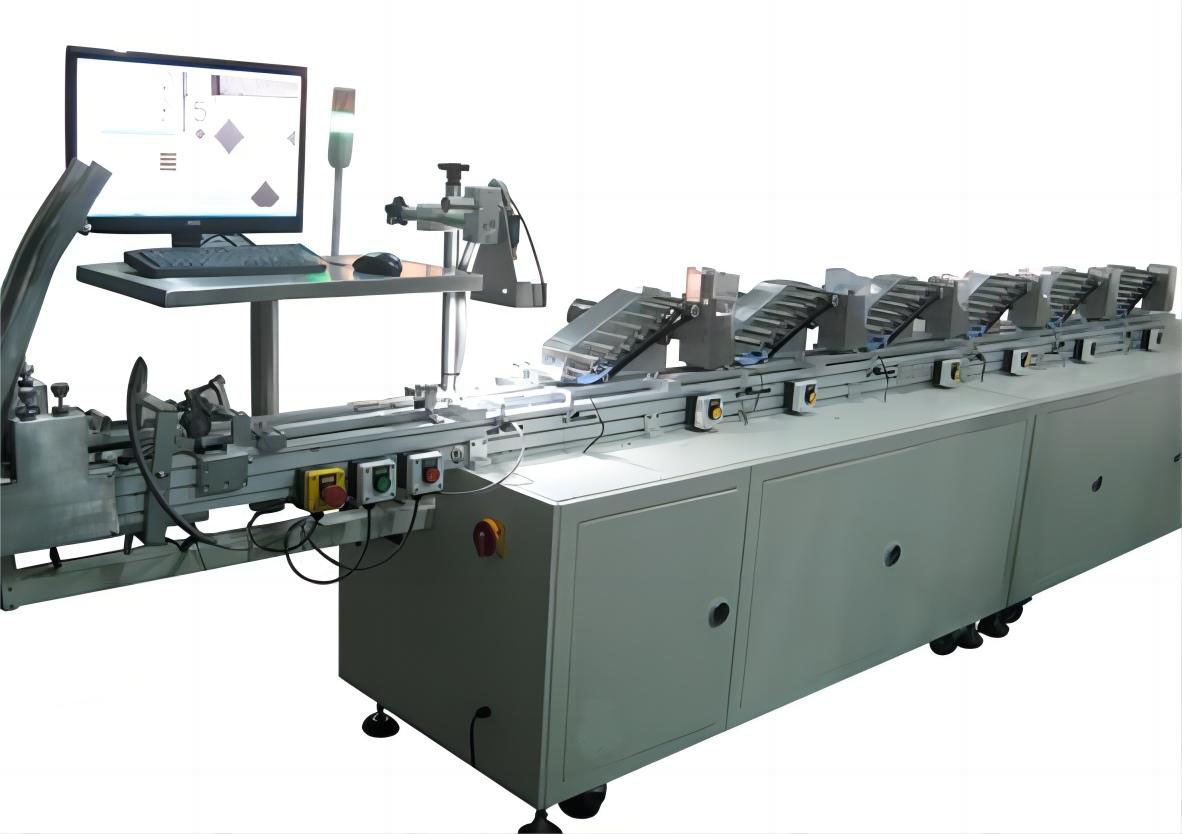
Cards enter from a poker table or a cutting line; the unit reads each card's suit and rank optically, routes it to the correct pocket and diverts damaged or non-standard cards. Recognition is optical rather than barcode-based, so ordinary retail decks work. The feed accepts poker (63 x 88 mm), bridge (57 x 89 mm) and custom formats, because one casino floor often runs more than one standard. Rejection is physical and automatic, not advisory.
| Parameter | WDA-PS-2000 |
|---|---|
| Processing capacity | 2,000 cards/hour (about 37 standard 54-card decks/hour) |
| Card size compatibility | Poker 63 x 88 mm, Bridge 57 x 89 mm, custom |
| Recognition accuracy | Above 99.9% |
| Counting | Built-in counter, deck-completeness verification |
| Rejection | Automatic diversion of damaged or non-standard cards |
| Power supply / consumption | 110 V or 220 V, 50/60 Hz / 150 W |
| Noise level | Below 60 dB |
| Display | 7-inch colour touch screen |
| Dimensions / weight | 800 x 500 x 400 mm / 35 kg |
| Operating environment | 0-40 C, 20-80% RH, continuous 24/7 duty |
At 150 W and below 60 dB it installs in a back office or beside a packing line without an electrical upgrade or a noise complaint.
Card handling once depended on mechanical alignment or pre-printed marks. Lightweight convolutional models on cheap embedded accelerators changed that: a benchtop machine can now classify rank and suit from the printed face under ordinary lighting, well above a 2,000-per-hour feed. Recognition is no longer the constraint - interpretation is.
Regulated gaming has spent years tightening auditability of table consumables, and card control that lived in a paper log is being pulled into the surveillance stack with timestamps and operator IDs. A manual sort produces four decks and a verbal confirmation. A machine-assisted sort produces four verified decks, a count per deck, rejection reason codes and a timestamp attachable to the shift record.
RFID-tagged cards extend the logic: individually identified cards turn sorting into reconciliation rather than counting, and 2,000 cards per hour reconciles a pit's daily inventory inside one shift.
The under-appreciated driver of demand in 2026 is not the casino floor. It is the collectible and trading card market, now a multi-billion-dollar category with its own grading infrastructure. Grading operations share a structural problem: the expensive skilled step is condition assessment, and it is starved of prepared input. Bulk submissions must be counted, screened for duplicates, separated by set and checked for damage first; done on a machine, the assessor receives a clean, counted, pre-segregated stream.
Two honest caveats. A sorter is not a grader: it flags damage thresholds and sorts by set, but ten-point condition grading stays a human or instrument judgement. And catalogue depth is the real integration cost - a unit trained on poker decks needs extra model work before it recognises a hundred thousand trading card faces.
Converters historically verified deck completeness by sampling: pull one deck per thousand, inspect, trust the process. Retail and export buyers are pushing toward full verification, especially for licensed decks where one missing card becomes a complaint, a reshipment and a chargeback. Full verification at 2,000 cards per hour is achievable precisely because the throughput is modest: a plant producing 15,000 decks a day needs every deck checked without a bottleneck, not a 40,000-piece-per-hour system.
Publicly cited estimates put the global playing card market in the low single-digit billions of US dollars, growing at a mid single-digit compound rate through the decade, with collectibles expanding faster from a smaller base. Premiumisation raises the cost of a sorting error, regulatory formalisation turns a labour task into a data task, and cheap embedded vision makes recognition viable at these volumes.
For retrieval and verification, usually yes: a 120-table property retires about 13,000 cards a day, roughly 6.5 machine hours before overhead. Speed only binds for very large tournaments, and even then a second unit beats a bigger machine, because redundancy matters when verification is a regulatory duty.
It is diverted rather than forced into the nearest class. A card of unknown identity should stop and be reviewed, never pass downstream on a guess.
Sorting projects fail on specification, not hardware. Three questions decide the configuration: which deck standards must the machine handle, what record must your compliance system receive, and what is the real daily deck volume rather than the peak.
WINDA Co., Limited - factory direct. Email: info@zowinda.com | WhatsApp: +86 186 2085 0485
Related: WDA-PS-2000 product page, 20/40-output card sorter, WDA-CS-3000 card sorter.
Sorter
Wechat QR code
wechat number:Copyright © 2022-2023 Winda, inc. All rights reserved