

For most distribution centres the sorting decision is no longer "which machine" but "how much machine, and when". A hub that buys capacity for a five-year forecast spends years paying for idle lanes. The modular rotary wheel sorting unit answers that mismatch structurally: a self-contained module of 6,000 to 8,000 items per hour with its own servo drive and controller, so a line grows by adding modules.
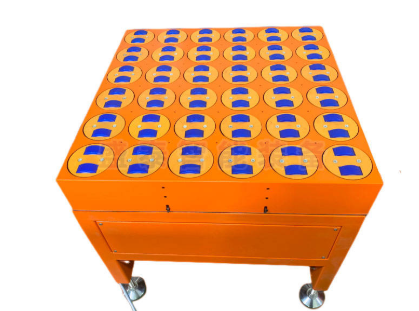
A rotary wheel module replaces the long continuous belt of a loop sorter with a short array of independently driven wheels set at an angle to the main line. When a parcel reaches its destination the wheels pivot or spin to push it sideways into the chute. Because the divert element is local, each module carries one servo drive, one I/O cluster and one network address instead of sharing a central drive across the run. A module can be swapped in under an hour, and extra outlets mean bolting modules onto the end of the line.
| Parameter | Specification | Practical Meaning |
|---|---|---|
| Sorting Capacity | 6,000 - 8,000 items/hour per module | Capacity scales with module count |
| Sorting Accuracy | at least 99.9% | Roughly one mis-sort per thousand parcels |
| Parcel Size and Weight | 50 x 50 x 10 mm to 600 x 500 x 400 mm; 0.01 - 30 kg | Padded mailers up to cartons |
| Number of Outlets | 4 - 24 (more on custom builds) | Add outlets without a new line |
| Drive System | Servo motor with variable frequency control | Per-module speed, lower idle draw |
| Control and Power | PLC with IoT link; 380V/50Hz; TCP/IP, Modbus, Profinet optional | Remote diagnostics; joins existing WCS |
In 2026 the clearest shift is commercial rather than mechanical. Operators tender for a baseline line plus an expansion option, and the module concept makes that option real. Starting at 4 outlets with a path to 24 or more, a depot commissions capacity matched to today's destination map, so capital sits only in modules that are actually sorting.
Older wheel sorters drove an entire run from one gearbox and clutch pack, so every station inherited the wear of the weakest link. Per-module servo drive removes that coupling: divert timing is tuned to the parcel rather than the line, and torque is applied only where a parcel is being diverted. Current draw logged per module reveals a binding bearing long before it becomes a jam.
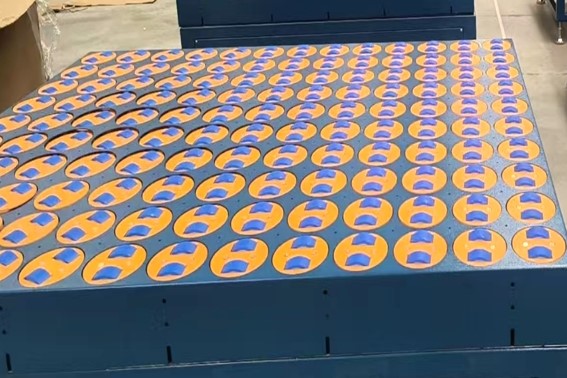
Induction scanning still happens upstream, but current designs add a decision layer at the divert point, where presence sensing confirms the parcel actually left the line and the controller re-tries instead of reporting a phantom success. Accuracy is therefore measured on parcels leaving the sorter, and exceptions arrive tagged with a module ID so a recurring packaging problem can be traced to a lane.
Building costs and permitting delays have pushed many 2026 projects toward retrofitting existing conveyor runs. A wheel module is short, mounts on standard frame sections and needs only power and a network drop, so it slots between an incline and a pack bench without civil works. Integration runs through APIs to platforms such as SAP EWM, Manhattan and Blue Yonder. Per-module drive also answers the energy question now asked in tenders: because wheels spin only under load, a line at half volume does not pay for idle rotation across the run.
| Architecture | Throughput Band | Best Fit |
|---|---|---|
| Rotary wheel module line | 6,000 - 8,000 items/hour per module | Depots and 3PL sites with shifting destination maps; expansion by adding modules |
| Circular cross-belt loop | 20,000 - 40,000 items/hour | National hubs with stable volume; expansion means a second loop |
| Linear narrow-belt sorter | 10,000 - 15,000 items/hour | Long straight footprints with many chutes; expand by extending frame |
The comparison is less about raw speed than about the cost of being wrong. A loop sized for a forecast that never arrives is expensive to under-use, while a module line can be under-sized on day one because the next module is a purchase order, not a rebuild. Read a circular cross-belt analysis before assuming a loop is required, and a narrow-belt comparison when floor length is the constraint.
| Sector | Typical Deployment | Value Delivered |
|---|---|---|
| E-commerce fulfilment | Order-volume-driven lines built from modules, reconfigured between campaigns | Flexible configuration, staged automation |
| Postal and express branches | Branch and transit-centre sorting with 4 to 12 outlets | Faster transit, reduced manual handling |
| Industrial warehousing | Material sorting and turnover tied to production flows | Stable operation, compact layout |
Labour availability comes first, since night-shift staffing binds at most mid-sized hubs. Order fragmentation is second: more destinations per parcel multiply divert decisions even when tonnage is flat. Capital discipline is third, favouring equipment financed in phases with a clear per-module cost per unit of throughput. Read a modular swivel wheel trend report and the product specification for the platform context.
Take a depot sorting 25,000 to 35,000 parcels daily into 8 to 14 destinations. Replacing two manual sorting walls with a module line removes a shift's worth of repetitive handling per lane and lifts accuracy from the low 90s to 99.9% or better, cutting redeliveries and SLA penalties while releasing labour to induction and packing. Standard configurations ship in 4 to 6 weeks.
Yes. Outlet positions and divert angles can be changed without replacing the module, which suits facilities whose destination map shifts between contracts or seasons.
Variable frequency servo drive typically cuts consumption by 30 to 40 percent against fixed-speed belt sorters, with the largest savings at low and medium fill rates. Service is quarterly lubrication of about 15 minutes per unit plus remote firmware updates, with two years of hardware warranty and five on the servo drive.
The modular rotary wheel sorting unit is best understood as a capacity instrument rather than a single machine. Its advantages are structural: 6,000 to 8,000 items per hour per module, 4 to 24 outlets on one frame, per-module servo drive that localizes wear and control, and standard protocols that let it join an existing WCS without a middleware project. When forecast accuracy is low and capital is expensive, the ability to add the next module only when volume arrives is the specification that matters most.
Sorter
Wechat QR code
wechat number:Copyright © 2022-2023 Winda, inc. All rights reserved