

Most fulfilment centres that automated outbound sorting years ago still unload arriving pallets by hand. De-palletizing is the last manual station on the floor, and in 2026 it absorbs the most scrutiny from operations directors facing wage inflation and tighter dock windows.
Sorting and labelling were automated because they are repetitive and easy to instrument. Pallet unloading is different: the incoming pallet is the most variable object in the building, and the robot must reach into a stack rather than pick from a layer. All three objections have now weakened, because mixed-SKU inbound is normal, camera recognition has replaced teach-and-repeat programming, and wage inflation has pushed payback into single-digit years. De-palletizing is a bottleneck to engineer rather than a job to staff.
The decisive change in this category is perceptual. Older depalletizers required an operator to teach every pattern, meaning a new session whenever a supplier changed its carton arrangement. The WDA-DP-600 inverts that: image recognition identifies the items and the handling sequence follows what the camera sees, without programming.
Three consequences matter. A new carton format does not trigger an engineering visit. The system judges whether to take one or two items per cycle, keeping cycle time efficient on small cartons without overloading the gripper on large ones. And when recognition fails the cell stops rather than forcing a pick.

A fixed-cell depalletizing robot built around a gripper that clamps from the top and side simultaneously. These figures drive layout, utilities and throughput planning.
| Parameter | Specification |
|---|---|
| Model | WDA-DP-600 |
| Gripper type | Two-sided gripper (top and side) |
| Applicable containers | Flat pallets |
| Max. item size | W600 x D600 x H500 mm |
| Max. item weight | 30 kg or less |
| Machine dimensions | W2200 x D3400 x H2700 mm |
| Machine weight | 2300 kg or less |
| Throughput | 600 pph (varies by item and stacking) |
| Power supply | 6 kVA, three-phase 200 V (excluding compressors) |
| Environment | 0 to 40 deg C, 20 to 90 percent RH, non-condensing |
| Safety | Operable without safety fence or surrounding buffer area |
| Installation space | 2.2 m x 3.4 m |
Most carton damage happens at the moment of separation. Clamp the top of a carton and lift, and it breaks free of the layer below with a sudden release; the load swings and the contents shift.
The two-sided gripper grips top and one side, then pulls the item out of the stack before transporting it. Pulling turns a vertical release into a controlled horizontal slide, lowering peak stress on the carton surface and reducing the risk of the item falling. Ask any vendor how their machine separates the first item from the layer beneath: a gripper relying on top-surface friction handles a perfect pallet well and a real pallet badly.
Traditional robot cells assume a fence, a light curtain and a buffer zone, which costs floor space and often costs the project entirely in existing buildings. This cell is specified as operable without a safety fence or surrounding buffer area, so it can sit directly in an existing pallet flow beside a walkway, subject to the site risk assessment still governing the final layout.
On throughput, 600 pieces per hour is roughly one item every six seconds, continuous, and it describes handling rate rather than a shift guarantee. A cell with 85 percent availability handles about 4,000 items per eight-hour shift, and the gap against manual output widens once breaks are counted. Because the process is serial, a modest accumulation buffer downstream returns more than squeezing extra cycles.
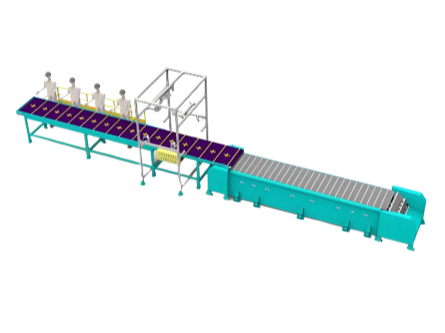
Three approaches compete for the same job. They are not interchangeable, and the right answer depends on how variable inbound really is.
| Criterion | Manual unloading | Robotic de-palletizer | Layer / bulk depalletizer |
|---|---|---|---|
| Mixed SKU on one pallet | Excellent, human judgment | Good, camera recognition | Poor, assumes uniform layer |
| Typical rate | 150-300 pph per operator | Up to 600 pph | 1,000 pph and above |
| Labour exposure | Continuous, 2-4 people | Supervision only | Supervision only |
| Damage risk | Handling-dependent | Low, pull-out separation | Higher on non-rigid cartons |
| Floor space | Minimal | 2.2 x 3.4 m cell | Large, fixed line |
| New carton changeover | None | None, recognition-based | Mechanical adjustment |
| Best fit | Low volume, high variety | Medium volume, high variety | High volume, single SKU |
In warehousing and logistics centres, unloading onto the receiving conveyor instead of breaking pallets down at the dock shortens dock occupancy when appointment windows are tight. Heavy cartons make the strongest case: a 30 kg item is a two-person manual lift under most handling guidance, so the manual process is either slow or non-compliant, and a 30 kg payload removes that conflict.
Labour availability, not cost, is now the primary driver, because the job cannot be staffed reliably on night shifts. Recognition is the competitive battleground: payload and reach have commoditised, and what differentiates systems is behaviour on a damaged or oddly stacked pallet. Compact, fence-free cells are winning brownfield projects, since most demand is for buildings with fixed space.
The subtraction is operating cost: 6 kVA of power, compressed air if needed, and residual supervision. Projects that include this line land in a multi-year payback; projects that omit it disappoint later.
Yes, because the sequence comes from image recognition rather than a taught pattern, so mixed items can be unloaded in sequence.
30 kg is the maximum item weight, so overweight items must be removed before the pallet enters the cell, normally via check-weigh at infeed. The 6 kVA figure excludes compressors, so air demand depends on the gripper configuration and should be confirmed at quotation.
Send your carton dimensions, maximum weight and stack patterns, and we will return a layout proposal with realistic throughput for your inbound mix, plus a quotation.
Email: info@zowinda.com
WhatsApp: +86 186 2085 0485
Related: cross belt sorter trends | swivel wheel sorter outlook
Sorter
Wechat QR code
wechat number:Copyright © 2022-2023 Winda, inc. All rights reserved