

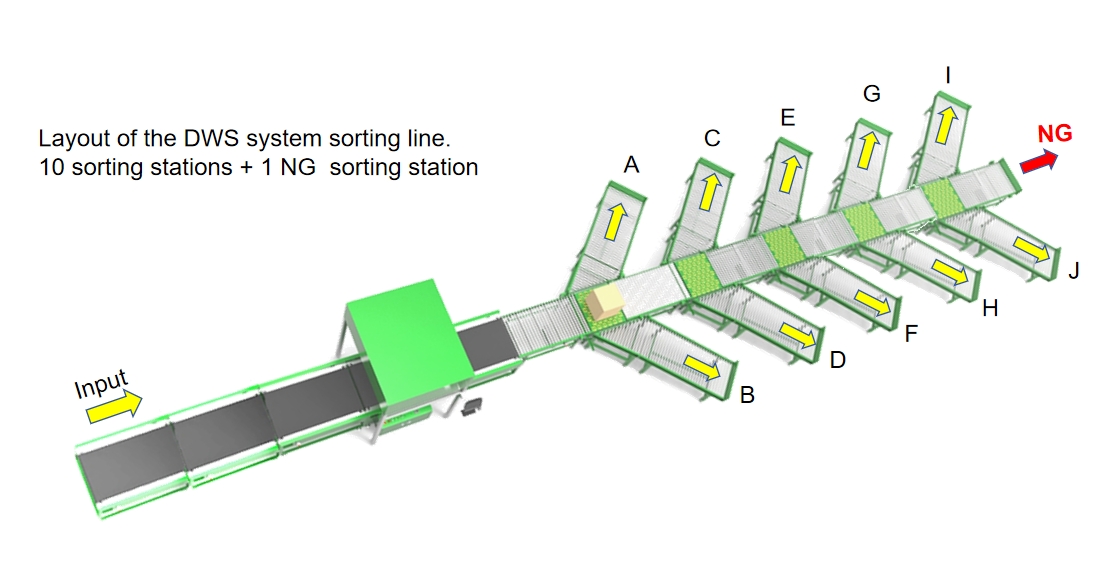
Most sortation business cases are built on speed: parcels per hour, metres per second, wheels per square metre. In 2026 that is the wrong denominator. On real operating data the binding constraint is not how fast a sorter moves a parcel, but how many distinct destinations it can hand that parcel to without a human touching it again. That is why the 10-station plus 1 NG configuration of the high-efficiency swivel wheel sorter has become the reference layout for regional hubs, cross-dock terminals and 3PL operators.
Every parcel leaving into a shared lane needs a second decision later — a manual re-sort at the van door. Every parcel leaving into a dedicated lane needs none. Lane count, not belt speed, therefore sets labour hours per thousand parcels, and labour is the line item that has grown fastest across parcel networks since 2023.
A 6-station and a 10-station machine can share the same wheel modules, control cabinet and footprint philosophy. What changes is the destination map. With six lanes against fourteen postcode groups, at least eight groups share a lane; with ten lanes plus the exception bay, the shared set collapses to four, and each collapse removes a downstream touch.
Field data from medium hubs puts a re-sort at 4 to 7 seconds of labour once search, re-scan and cage handling are counted. At 6,000 parcels per hour with 30 percent of volume needing a second decision, a layout where only 12 percent does recovers roughly 32 labour-hours per shift — one full-time equivalent, on a machine costing a fraction of a cross-belt loop.
| Design parameter | 6-lane layout | 10 + 1 lane layout |
|---|---|---|
| Dedicated destinations | 6 | 10 plus exception bay |
| Shared-lane share of volume | Typically 25–35% | Typically 10–15% |
| Secondary touches | Concentrated at peak | Absorbed by dedicated lanes |
| Typical use case | Single-carrier depot | Multi-carrier hub, 3PL, cross-dock |
An NG station is usually sold as a safety net: unreadable labels, oversize parcels and weight anomalies go there instead of stopping the line. Operationally it is more useful, because it converts invisible failure into counted failure. Volume through the bay, segmented by reason code, is the most honest KPI a sortation line produces: a rising no-read rate points at upstream label quality, a rising oversize rate at the parcel mix drifting past design limits.
Treat the bay as a staffed position with a scanner and a scale, not as a bin. In the 10 + 1 layout it sits at one end of the station row, so corrected parcels go straight back to induction. Any station, including the NG position, can be re-purposed as a normal output in a quoted 2 to 4 hours with hand tools — the layout stays adjustable for peak instead of permanent.
Parcel economics in 2026 are dominated by dimensional weight, not dead weight. A sorter without dimensioning, weighing and scanning at induction only moves boxes; with DWS it also produces the commercial record of the shipment. Dimensioning at plus or minus 5 mm, weighing at plus or minus 10 g and omnidirectional scanning at line speed let the WCS route, rate and later prove the rate.
Swivel wheel sortation is a contact-transfer technology: angled wheels steer the parcel across the deck rather than tipping it into a chute. It handles a wide envelope for its footprint, but the envelope is finite and must be checked against the actual mix, not a marketing range. The 10 + 1 configuration is rated for items from 50 x 50 x 10 mm to 600 x 500 x 400 mm and 0.01 to 30 kg, at 6,000 to 8,000 items per hour and 99.9 percent accuracy or better.
| Parameter | Specification | What to verify in your mix |
|---|---|---|
| Throughput | 6,000–8,000 items/h | Real peak hour, not daily volume over 24 |
| Accuracy | ≥99.9% | How misroutes are reconciled |
| Stations | 10 sorting + 1 NG | Destination count for the next three years |
| Parcel size | 50×50×10 to 600×500×400 mm | Oversize share in the last 90 days |
| Parcel weight | 0.01–30 kg | The heavy tail above 25 kg |
| Scanning | Up to 3.5 m/s, 1D and 2D | Label placement discipline upstream |
Two rows deserve scrutiny. Very light flat mail can skate on wheel decks at speed, so wheel compound and discharge angle matter more than the minimum-thickness figure. At the top end, a tall but light parcel is the classic tipping case; the answer is lower deck speed or a different machine class — compare the cross-belt carrier principle.
No sorter reaches its rated rate on its own. The 6,000 to 8,000 figure assumes a steady, singulated, correctly oriented stream at the infeed. In practice starvation and surge at induction, not wheel speed, set the achievable rate — which is why the upstream separation stage deserves as much engineering attention as the deck. Our analysis of AI vision singulation covers that stage: if parcels arrive in clumps, a ten-lane machine behaves like a six-lane machine with a queue.
Three demand patterns are driving the 10-station configuration. Regional and second-tier carriers are building micro-hubs to shorten last-mile distance, and a micro-hub has many destinations but modest volume — exactly the shape that rewards lane count over raw speed. Cross-border consolidators must separate by destination country and customs lane at once, which consumes stations fast. And 3PL operators running several client accounts on one floor need physical separation without buying a second machine.
The constraint is floor space and power rather than capital: a wheel-based 10 + 1 line occupies a fraction of a cross-belt loop's footprint at comparable piece rates, which is why dock retrofits dominate 2026. See our omnichannel sortation overview.
Send your destination list, parcel mix and peak profile, and our engineers will return a lane map, throughput estimate and footprint drawing within two working days.
Email: info@zowinda.com | WhatsApp: +86 186 2085 0485
View the full specification of the 10 + 1 swivel wheel sorter →
Sorter
Wechat QR code
wechat number:Copyright © 2022-2023 Winda, inc. All rights reserved