

Every parcel sorter is sold by its headline number, yet in real hubs the sorter rarely runs at that number - and the reason is usually not the sorter at all. It is the chaotic, overlapping stream of boxes arriving in front of it. In 2026, the machine that decides whether a hub hits its design throughput is the singulation system.
The WINDA Single-piece Logistics Separation System is a vision-guided front-end that converts a mixed, touching, overlapping parcel stream into a controlled single-file flow, rated at a separation success rate of 99% or higher with belt speed adjustable from 1.2 to 2.2 m/s. The logic is simple: a sorter can only process parcels that reach it one at a time, so if the front-end fails to separate one parcel in fifty, a hub running 10,000 parcels per hour accumulates 200 manual touches per hour. That is why 2026 line designs treat singulation as a measuring point with its own SLA - separation rate, not just belt speed. Here is what changed going into 2026, and where the economics work.
Traditional singulation was mechanical: accelerators and dividers that physically shove packages apart. It was tuned for one parcel profile and punished everything else - polybags, soft mailers, irregular boxes. Three shifts have made vision-based separation the default for new lines in 2026:
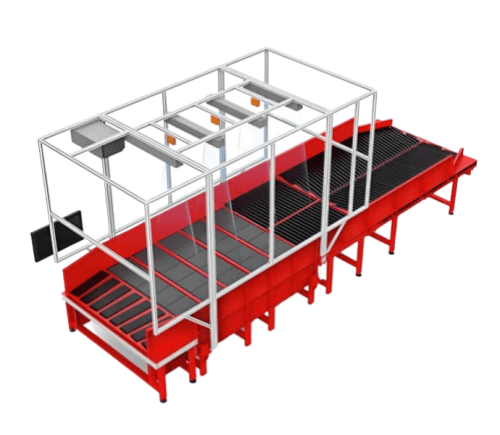
The workflow is a closed loop between perception and actuation: binocular cameras capture 3D spatial data even when items touch or slightly overlap; an industrial computer models each package in 3D and runs divergence and separation algorithms to compute the optimal path for every parcel in the cluster; then belt speed adjusts dynamically via the hard-trigger linkage while automatic centering ensures each parcel arrives at the sorter not only alone, but correctly positioned - improving its read and diversion accuracy.
| Parameter | Single-piece Logistics Separation System |
|---|---|
| Conveyor speed | 1.2 - 2.2 m/s, dynamically adjustable |
| Separation success rate | >= 99% |
| Vision system | Binocular camera + real-time 3D modeling |
| Data protocol / control | TCP/IP; hard-trigger line linkage module |
| Surface detection | Reflectivity detection (10% threshold) |
| Centering / clutter | Dynamic automatic centering; tolerant of overlap and disorder |
| Package weight / size | Approx. 0.3-60 kg; 150 x 150 x 15 mm up to 1000 x 700 x 700 mm |
| Typical flow rate | >= 4,000 pieces/hour depending on speed and mix |
| Position / power | Front-end of sorting line; AC 380 V three-phase |
| Certification | CE / ISO9001 |
Mechanical bulk singulators - such as the semi-automated bulk singulator WDA-BS-7000 - remain sound for specific duty profiles; vision-based systems win when input is genuinely mixed:
| Criteria | Mechanical singulation | Vision-based separation |
|---|---|---|
| Input stream | Needs pre-conditioned single-layer feed | Accepts touching, overlapping parcels |
| Parcel variety | Tuned per profile; soft items difficult | Shape-agnostic; 3D model per item |
| Downstream positioning | Spacing only | Spacing plus dynamic centering |
| Handling | Contact-based; risk for fragile items | Contact-free; belt speed is the only actuator |
| Best fit | Single-profile bulk flows | High-mix e-commerce, express hubs, 3PL |
Labor is the trigger, accuracy is the justification. The role that disappears first is not the sorter operator but the person feeding it - repetitive lifting from a bulk pile is among the hardest jobs to staff. A 99%+ separation system removes that position and the correction queue with it.
Integration depth is the new purchasing criterion. Buyers now evaluate singulation by its API surface: standard TCP/IP, compatibility with WMS platforms such as SAP EWM, Manhattan and Blue Yonder, and documented WCS APIs are baseline requirements.
The business case rests on four measurable effects. Direct labor: the feed is fully automated, removing the most staff-resistant position in the hub. Sorter utilization: with a stable, centered stream, the downstream sorter runs measurably closer to design capacity - which is why pairing with equipment such as the automated parcel sorter and circular cross-belt sorter is the standard reference architecture. Error reduction: fewer unseparated parcels, fewer manual corrections. Future-proofing: separation logic is software, so a change in parcel mix is a model update, not a mechanical rebuild.
WINDA (Shenzhen, China; CE and ISO9001 certified) delivers the system with factory-direct pricing, 4 to 6 week lead times, and commissioning, training and tuning included - keeping a vision front-end within reach of mid-sized hubs, not only tier-one networks.
None. The binocular vision system identifies individual items even when they are touching or slightly overlapping.
A flow rate of 4,000 pieces per hour or more depending on belt speed and parcel density. Integration is via standard TCP/IP with support for SAP EWM, Manhattan and Blue Yonder. Maintenance is light: monthly lens cleaning, quarterly calibration and annual software updates, with self-diagnostics flagging camera issues before performance drops.
Tell us your parcel profile, peak volume and conveyor layout, and WINDA's engineers will size a separation system for your facility.
Email: info@wdsort.com | WhatsApp: +86 186 2085 0485
Product page: Single-piece Logistics Separation System | Full range: parcel sorter category.
Sorter
Wechat QR code
wechat number:Copyright © 2022-2023 Winda, inc. All rights reserved