

2026 Technology Outlook. Buyers once compared sorters on chute count and headline throughput. In 2026 the decisive part sits inside the machine: the carrier. Each cross-belt carrier is an independently driven mini-conveyor, and that one choice governs damage rates, mis-sort economics, energy draw and how cheaply a line grows from 50 to 300 chutes.
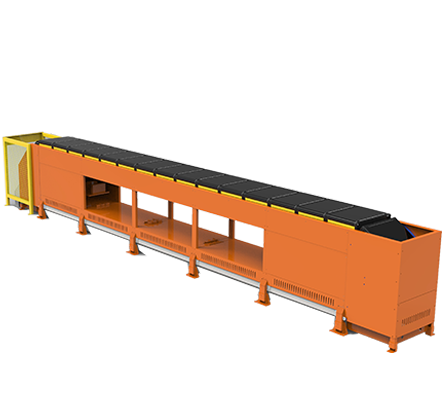
On a narrow-belt or shoe sorter the parcel rides a common belt and is pushed laterally off it by a diverter or shoe. The parcel therefore slides, and sliding is where most damage, jam clearance and mis-sort events begin. On a cross-belt machine the parcel rides a carrier whose belt runs perpendicular to travel; at the target chute that belt rotates and the parcel leaves in a direction it is already moving.
Discharge becomes a controlled rotation rather than a lateral shove, so parcels keep their orientation and land label-up for downstream scanning. Independent drive gives millisecond timing, so chutes sit closer together without parcels bridging two of them. With no sliding interface, the wear parts that dominate shoe sorter maintenance largely disappear.
Hence the specification: a 50-gram poly mailer and a 30-kilogram carton must ride the same carrier.
Induction used to be a barcode problem: scan tunnel, no-read lane, operator to resolve exceptions. The 2026 default is a camera array reading 1D, 2D and OCR in one pass, with the WCS resolving addressing instead of a host system. The gain is not read rate but exceptions: a parcel with a torn label yet legible address needs no keying station.
This machine lists TCP/IP, PROFINET and EtherCAT together, which is itself a 2026 statement. EtherCAT carries carrier synchronisation and discharge commands with the determinism a 2.5 m/s line needs, while PROFINET and TCP/IP expose it to the plant network. The sort controller is no longer a black box but a node in the plant data model.
The largest hidden cost was never hardware but on-site tuning at partial speed while engineering chases mis-sort patterns. Simulation-first commissioning is now expected: chute allocation and surge behaviour are validated against a model of the customer's parcel mix, so the machine arrives with routing already stressed.
| Parameter | Specification |
|---|---|
| Sorting capacity | 8,000 - 12,000 parcels/hour |
| Belt speed | 1.5 - 2.5 m/s, adjustable |
| Parcel size range | Min 100 x 100 x 10 mm / Max 600 x 800 x 400 mm |
| Parcel weight | 0.05 - 30 kg |
| Sorting accuracy | Greater than 99.99 percent |
| Number of chutes | Customisable, 50 - 300 |
| Control system | PLC plus WCS (Windows / Linux) |
| Communication | TCP/IP, PROFINET, EtherCAT |
| Energy saving | 20 - 30 percent versus conventional systems |
Chute count is where projects are won or lost commercially, because a 50-chute and a 300-chute machine are the same platform. The decision is statistical, not mechanical, and belongs on a real 30-day parcel mix. Shipping to 180 postcodes daily on 50 chutes forces multi-destination chutes and a second pass, doubling handling, so match chutes to the destinations covering 85 to 90 percent of volume and recirculate the tail. A chute that fills faster than it empties becomes a recirculation source, which is why bag-change discipline rather than machine speed sets the ceiling, and why operations with three or four outbound waves need fewer chutes than a continuous-flow 3PL.
| Family | Discharge method | Where it wins |
|---|---|---|
| Linear cross belt | Per-carrier rotating belt | Fragile and label-critical parcels; long halls; 50 - 300 chutes; lowest wear cost |
| Narrow-belt linear | Fixed belt plus diverter | Throughput per metre on robust cartons; lower capital cost |
| Shoe sorter | Sliding shoes push sideways | Very high throughput on standardised totes; higher wear |
| Swivel wheel | Angled wheel modules steer | Compact footprints, tight buildings, medium throughput |
| Circular cross belt | Per-carrier belt on a loop | Maximum throughput where floor space allows a ring |
The cross belt is rarely cheapest per parcel per hour, and often cheapest per undamaged parcel delivered: for 3PLs handling electronics or subscription boxes the damage-rate difference repays the premium within two or three peak seasons.
Four segments drive most of the order book. E-commerce fulfilment needs one line serving cartons, poly mailers and subscription boxes on the same wave, with chute counts that shift as the SKU mix changes. Postal streams use the 100 mm lower bound to run small-format mail alongside 30 kg cartons. Regional hubs value 99.99 percent accuracy because it needs no re-check lane. Pharmaceutical and apparel add the fastest-growing case of 2026: returns.
Land is the binding constraint. Industrial floor space near distribution corridors has repriced faster than equipment. A linear layout fits halls that cannot take a ring, so buyers select on footprint per chute rather than peak throughput.
Retrofit over greenfield. Much 2026 demand replaces lines installed between 2015 and 2018 whose mechanicals are serviceable but whose control layer cannot speak to a modern WCS. The question has shifted from throughput to migration path.
Labour sets payback. Sorting is repetitive night-shift work and the constraint is recruitment, not wage rate. A line that cannot be staffed has zero throughput regardless of its rating.
Lead time is 8 to 12 weeks with expedited production available. Three tests matter. A sustained throughput test at the specified mix for a continuous shift, not a burst: many lines pass ten minutes and fail eight hours. A mis-sort audit tracing rejected parcels to their cause, separating scanner no-reads from allocation errors from discharge faults. And a chute-full recirculation test, since behaviour when bagging falls behind sets availability.
Three cost lines dominate over ten years: energy, where the 20 to 30 percent reduction compounds; wear parts, where removing the sliding interface removes the largest recurring consumable; and mis-sort cost, where 99.99 percent on 10,000 parcels per hour means one wrong parcel hourly rather than ten. Where damage and returns are material the arithmetic favours the cross belt.
For layout comparisons, review the linear narrow-belt sorter, the circular cross-belt sorter where a ring fits, the Z-type diverging sorter, and the automated parcel sorter. Background reading sits in our narrow-belt outlook and singulation analysis.
Send 30 days of parcel dimension and weight data plus your destination count, and we return a chute configuration, throughput estimate and footprint drawing.
WhatsApp: +86 186 2085 0485 | Email: info@wdsort.com | Contact form
Specifications are project-specific and confirmed at technical review.
Sorter
Wechat QR code
wechat number:Copyright © 2022-2023 Winda, inc. All rights reserved