

Punching is the moment a printed card sheet becomes individual cards - and where most invisible yield is lost. A sheet punched off-register or with a burr cannot be recovered. The WINDA Card Punching and Sorting Machine WDA-PS-20000 attacks this directly: ball-screw feed for 0.1 mm class registration, hydraulic punching tuned for stable force, and integrated single-card sorting. This article treats punching as an economic variable.
Card production loses money at the punch stage in two ways. The first is visible scrap: a sheet punched 0.3 mm off-register is rejected on the spot, and at 20,000 cards per hour a one-percent scrap rate consumes 200 cards every hour. The second is costlier: a card that passes punching with a slight burr or stressed corner may fail at embedding or personalization days later, when far more value has been added.
This is why a punch station should be judged not only by throughput but by first-pass yield and by how fast operators restore it after a changeover - the two numbers the WDA-PS-20000 is built around.
The mechanical heart of the machine is a high-precision ball-screw feed paired with a sensitive positioning sensor. Ball screws convert rotary motion into linear travel with minimal backlash, so the sheet arrives at the punching point identically on the first stroke and the ten-thousandth. Each punching point is parameter-adjustable numerically.
Why does 0.1 mm matter commercially? Chip modules, contact pads and antenna windows all assume the punched hole or card edge sits within a narrow tolerance. On dual-interface and RFID cards the antenna loop must align with the punching position, or transponder yield drops even though every component tested fine earlier. Stable registration protects the electrical yield of the whole line.
The punching unit uses an oil cylinder as its power source. Hydraulic force builds smoothly and holds full pressure through the material, producing cleaner cut edges with fewer burrs and micro-cracks. It is also quieter, and punching speed is adjustable - which matters when thin PETG sheets behave differently from thick multi-layer PVC or paper laminates.
Adjustable force also extends die life: punching too hard wears edges faster, punching too soft leaves incomplete cuts that operators fix by hand. Dialing force per material keeps both the die budget and the scrap rate under control.
Card sheets arrive in standard grids - 3x8, 4x8, 5x5 - and every switch historically stopped the line: new fixtures, re-taught positions, scrap from the first sheets. On the WDA-PS-20000 changeover becomes a data operation: select the layout, confirm stored parameters, run a verification sheet. An hour of stopping shrinks to minutes.
For a job-shop card plant running many short orders, changeover frequency matters more than peak throughput: a machine with fast, repeatable changeover delivers more good cards per week than a nominally faster machine that spends its day being re-registered.
A semi-automatic punch hands the operator a mixed stream of good cards and pattern waste to separate by hand. The WDA-PS-20000 instead adds single-card sorting on top of punching: cards are separated into independent collection boxes, sorted by pattern, so good product and waste never mix.
The effect is threefold. Labor: one operator runs the line instead of two. Traceability: each box corresponds to a defined output, so counts per box become counts per order. Quality data: a box filling faster than expected means the line is drifting - visible immediately. As plants connect equipment to MES and ERP in 2026, this box structure is the natural place to attach counters for order reconciliation.
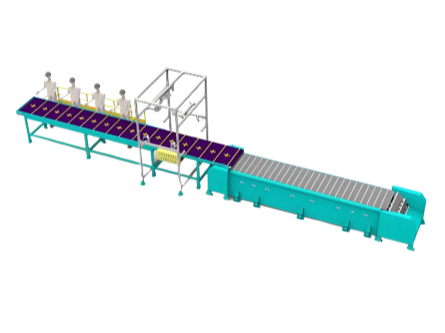
Traditional plants replace dies on a fixed schedule or after burrs appear in product. The 2026 approach treats die condition as data: the machine already counts cards into individual boxes, and plants extending this with pressure monitoring can see a dulling die as a slow rise in force per stroke, days before it produces a burr in shipped product.
The WDA-PS-20000 handles PVC, ABS, PET, PETG and paper laminates. Each stresses punching differently: PVC cuts predictably; PET and PETG are tough and springy, demanding sharper dies and gentler force curves; paper blunts edges fastest. One machine spanning all five lets the plant chase recycled-PET and paper-based card programs without a second punch line per material trend.
| Parameter | Specification |
|---|---|
| Output | 15,000-20,000 pcs/hour |
| Punch precision | Plus/minus 0.1 mm |
| Applicable layouts | 3x8, 4x8, 5x5 and similar grids |
| Applicable materials | PVC, ABS, PET, PETG, Paper |
| Control mode | PLC + Servo system |
| Punching power | Oil cylinder, speed adjustable |
| Feed system | High-precision ball-screw with positioning sensor |
| Power supply | AC 380V 50Hz, general power 4 kW |
| Dimension / weight | L3420 x W850 x H1520 mm, approx. 850 kg |
| Operator | 1 person |
The punching-plus-sorting combination serves three buyer groups. Card manufacturers use it as the bridge between printing and lamination or embedding. Personalization bureaus value the pattern sorting when producing several designs from one sheet run. Plastic converters - loyalty, gift and hotel key cards - use it as a low-labor finishing step. Related reading: our earlier card punching machine trends for 2026, the high-speed card sorting machine with 20/40 outputs, and the swivel wheel sorter selection guide.
Three forces shape punch-station buying this year. Contactless and dual-interface volumes keep rising, and antenna tolerances punish weak registration harder than chip cards ever did. Sustainability programs push PETG and recycled substrates into the sheet mix, making force-tunable punching a requirement. And labor economics push integration: plants now specify one operator running punching and sorting together - the configuration the WDA-PS-20000 standardizes.
When auditing a punching line, score it on five points: documented registration accuracy on your own layouts; changeover time in minutes with scrap from the first sheet; box-level sorting with per-box counts; force adjustability across your material list; and data interfaces for stroke counts. A machine scoring well on all five typically pays back through scrap reduction alone.
Evaluate the WDA-PS-20000 for your sheet sizes and layouts. Send your sheet format and material list, and our engineers will return a yield estimate and configuration proposal.
Email: info [at] zowinda [dot] com | WhatsApp: +86 186 2085 0485 | Product page: WINDA Card Punching and Sorting Machine
Sorter
Wechat QR code
wechat number:Copyright © 2022-2023 Winda, inc. All rights reserved