

Ask operators why they bought a swivel wheel sorter and most answers circle the same spec sheet: 20,000 pieces per hour, 99.9 percent accuracy, dozens of outlets. But the number that quietly decides the purchase in 2026 is the smallest one on the sheet. The WINDA High-Efficiency Swivel Wheel Sorter accepts items down to 10 grams, a floor low enough to include blister packs, documents, small spare parts and jewellery parcels that defeat most high-throughput diverters. This article examines what the 10 g threshold unlocks, how the technology compares against tilt-tray and cross-belt alternatives, and why the 6 to 40+ outlet range turns capacity into a subscription you can grow into.
The headline figures for context: up to 20,000 pieces/hour, item sizes from 100 x 100 mm to 600 x 600 mm, weight range 10 g to 30 kg, accuracy above 99.9 percent, belt speed 0.5 to 2.5 m/s, and recognition spanning barcode, QR code, OCR and optional RFID.
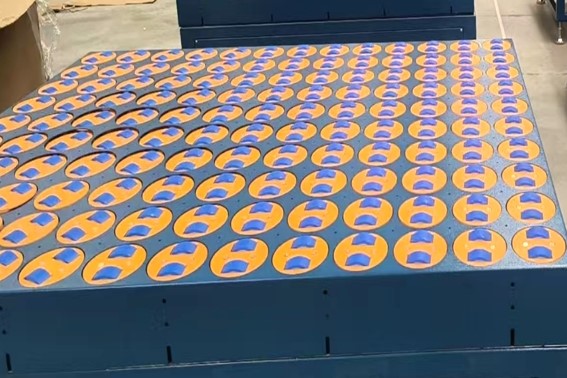
Every diverter technology has a physics problem at the light end. Cross-belt sorters carry items on a belt mounted in a carriage; a 30-gram envelope can slide, flutter or catch air as the carriage tips. Tilt trays share the same instability. A swivel wheel array sidesteps this: the item never leaves the conveying surface, and wheels beneath the product rotate to steer it into a lane, so guidance persists until the divert completes.
The commercial consequence is that one machine covers the entire band from a 10 g document to a 30 kg carton, eliminating a separate light-item line for pharmacies, telecom card packs, spare-part dealers and duty-free retail.

Swivel wheel array steering mixed-weight parcels into lanes.
Capacity claims deserve arithmetic. At the top belt speed of 2.5 m/s with a realistic induct pitch of roughly 450 mm for small mixed parcels, the line presents about 5.5 items per second, which compounds to just under 20,000 pieces per hour across two shifts of clean feeding. At a gentler 1.5 m/s, the same machine still exceeds 10,000 pieces per hour.
That speed range matters more than the ceiling. Running 0.5 m/s during a small-batch pharmaceutical wave and 2.5 m/s during an e-commerce peak on the same hardware means the sorter follows the order profile instead of forcing operators to buffer around it.
The 2026 buyer rarely compares brands first; the comparison that matters is between technologies. The table below summarises where each wins.
| Criterion | Swivel Wheel | Tilt Tray | Cross Belt |
|---|---|---|---|
| Gentle handling | Excellent | Good | Moderate |
| Maintenance cost | Low | Medium | Higher |
| Footprint | Compact | Large | Very large |
| Noise level | Quiet, below 70 dB | Moderate | Louder |
| Initial investment | Lower | Higher | Highest |
Read as a whole, the pattern is consistent: swivel wheel technology trades a modest ceiling on single-item weight for the lowest cost, quietest and most compact option in the class. For hubs whose volume is dominated by parcels under 30 kg, that trade is usually favourable. Cross-belt earns its premium where cartons beyond the wheel range or extreme chute density dominate; tilt tray survives mainly in legacy installs. Facilities under 70 dB constraints find this profile aligned with mixed-use buildings.
Outlet count is where sorter purchases usually overreach: buyers order 40 chutes for a volume profile that needs 18, and pay for idle steel for years. The configurable 6 to 40+ outlet range inverts that logic. A regional 3PL can start at 8 to 12 lanes, then extend as client counts grow, because the wheel array's divert points are modular rather than mechanically coupled to a fixed loop length.
Plan the expansion in the electrical cabinet, not the steelwork: reserve chute positions and drive capacity at commissioning so later lanes drop in without re-routing.
Modular chute banks extend the outlet count as volume grows.
| Parameter | Specification |
|---|---|
| Sorting capacity | Up to 20,000 pieces/hour |
| Item size range | 100 x 100 mm to 600 x 600 mm |
| Item weight range | 10 g to 30 kg |
| Sorting accuracy | 99.9%+ |
| Number of outlets | Configurable 6 to 40+ |
| Conveyor speed | 0.5 - 2.5 m/s, adjustable |
| Recognition technology | Barcode, QR code, OCR; RFID optional |
| Power supply | 380V/50Hz or custom voltage |
Two rows deserve a second look. The 100 x 100 mm minimum size pairs with the 10 g weight floor, so flat mail, card packs and small polybags are genuinely in scope, not edge cases.
A sorter is only as good as what it can read. The base configuration reads 1D barcodes and QR codes at line speed, covering the overwhelming majority of parcel labels. OCR extends coverage to address blocks and unpainted labels, useful for postal flats and returns. Optional RFID closes the gap for closed-loop flows, returnable totes, and retail distribution where item-level tags already exist. In 2026 the practical pattern is to start with barcode and QR, add OCR once the lane map stabilises, and deploy RFID only where tag infrastructure upstream already pays for itself.
Four application profiles recur across deployments. E-commerce and 3PL hubs use the wide weight band to merge polybag and carton flows onto one line. Courier and postal operators value the 100 x 100 mm floor for documents and small flats alongside standard parcels. Retail distribution chains use wheel gentle handling for apparel and boxed goods, where a tip-tray bang on a rigid corner is a returns generator. Pharma, electronics and jewellery operations exploit the 10 g floor and quiet sub-70 dB profile for value-dense small items.
Three currents define the 2026 market for wheel-based sortation. First, small-parcel share keeps climbing as social commerce and spare-part e-commerce grow, pushing the light-item floor from a footnote to a headline criterion. Second, floor-space economics push buyers toward compact footprints, and the swivel wheel loop remains the smallest footprint per outlet in its class. Third, noise compliance tightens as more sortation moves into urban facilities, making the sub-70 dB rating a permit-relevant spec.
The economics are unusually well documented for this class. Typical annual labour savings run from 150,000 to 400,000 US dollars depending on shift structure, error-rate reduction reaches 95 percent fewer mis-sorts, throughput gains versus manual sorting reach 5 to 10 times, and typical payback lands between 18 and 30 months. The 10 g capability compounds the case: eliminating a dedicated light-item line removes its operators, footprint and maintenance contract from the cost base. When modelling payback, include the retired line's costs, not just headcount on the main sorter.
Sorter
Wechat QR code
wechat number:Copyright © 2022-2023 Winda, inc. All rights reserved