

Every conveying line is judged by its straight sections, but it is usually won or lost at its curves. In practice, the turn a belt turning machine performs is a layout decision that locks in floor space, transfer count, jam frequency and product orientation for the life of the facility. As 2026 brownfield retrofits accelerate, WINDA sees more operators treat the curve section not as filler between straights but as the highest-leverage geometry decision on the drawing.
The real numbers of the WINDA Belt Turning Machine frame that decision: turning angles of 30/45/90/180 degrees with custom angles available, variable-frequency conveying of 0.1 to 1 m/s, belt widths from 500 to 1400 mm, inner radii from 1270 to 2200 mm, and motor power of 0.75 to 2.2 kW.
An inner turning radius of 1270 to 2200 mm sounds like a small spec until you price floor space per metre. At a 90-degree turn with a 1270 mm inner radius, the machine occupies roughly a 2.5 by 2.5 m corner; at 2200 mm it grows past 3.4 by 3.4 m before guide rails and clearance. Across four or five direction changes in a typical line, that difference is often 15 to 25 square metres of building.
The right response is to stop asking "which radius is best" and ask "which turn needs which radius". Tight 1270-1400 mm radii suit small, rigid, flat-bottomed items such as envelopes and polybags. Generous 1800-2200 mm radii belong where items are tall, soft or unstable. Choosing radius per turn instead of per project is the cheapest footprint optimisation available in 2026.
A recurring mistake is building a U-turn from two 90-degree curves joined by a straight segment. Each junction is a transfer point where the product changes support surface and a misaligned box can jackknife. The WINDA 180-degree belt turn removes that intermediate straight and both of its transfer edges, replacing them with one continuous guided arc.
The consequences are cumulative: fewer jam locations, less label abrasion against guides, and no re-gapping between parcels, which keeps downstream scanners fed with a predictable pitch. For serialized goods, preserved pitch through the turn is often the difference between a read rate above 99 percent and one that drifts during peak hours.
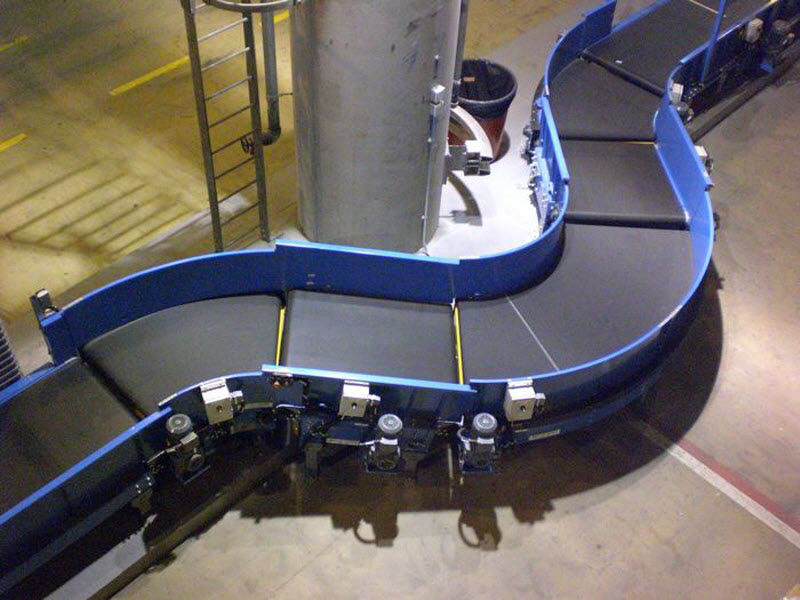
WINDA Belt Turning Machine: continuous belt guidance through wide-radius curves.
Conical roller curves remain common because they are inexpensive, but they impose a physics tax: on a tapered roller bed the outer edge of a product travels faster than the inner edge, so boxes skew and unstable items rotate. A friction belt surface moves the whole footprint at one set speed, up to 1 m/s here, so orientation is preserved. That matters more in 2026 because vision systems do more of the sorting work: a parcel exiting a turn skewed by 15 degrees presents its label off-axis to the next reader. Operators who replaced roller curves with belt curves commonly report improved downstream read rates without touching a single scanner.
Variable-frequency speed control from 0.1 to 1 m/s is not just an energy feature, it is traffic control. The curve is where product density is highest, because the arc shortens the effective path while the upstream straight keeps feeding items into it. Running the curve slightly slower than the feeding straight prevents surging at the apex, the classic root cause of wedged boxes. The 0.75 to 2.2 kW range makes this tuning cheap, since a curve section draws a fraction of what a sorter consumes.
| Parameter | Specification |
|---|---|
| Turning angle | 30 / 45 / 90 / 180 degrees, custom angles available |
| Conveying speed | 0.1 - 1 m/s, variable frequency speed regulation |
| Standard belt width | 500 / 800 / 1000 / 1200 / 1400 mm |
| Inner turning radius | 1270 - 2200 mm, optional per turn |
| Motor power | 0.75 - 2.2 kW |
| Frame material | Carbon steel with plastic spray coating (standard) / 304 stainless steel (optional) |
| Belt material | PVC (standard) / PU / anti-static / food-grade (optional) |
| Operation mode | Continuous or intermittent; single or multi-layer structure |
Two rows matter most. The five belt widths let one curve family serve a document lane and a bulk parcel lane with common spares, and the single-or-multi-layer option lets 180-degree returns be stacked vertically, turning a U-turn into a mezzanine-to-ground elevation change.
Curve sections are where product contact time is longest, so belt and frame selection is an environmental decision. Food and bakery lines pair the food-grade PU belt with the 304 stainless frame so washdown chemicals do not corrode the arc. Electronics and battery logistics specify the anti-static belt. General flows run the standard PVC belt on powder-coated carbon steel, the most economical configuration in dry halls.
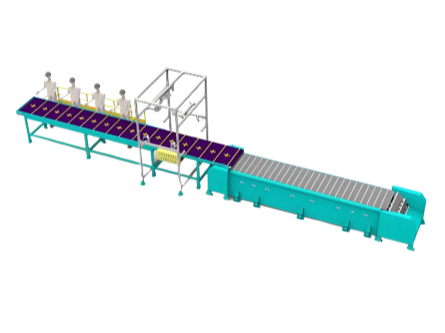
A 90-degree belt curve feeding a downstream sorting lane in a parcel facility.
Three placements keep proving their return. First, before induction: a gentle 30 or 45-degree curve lets parcels arrive in single file, already aligned, raising singulation efficiency upstream of scanners. Second, between sorter discharges and consolidation lanes: 90-degree curves route merged streams without another active sortation level. Third, as the vertical return: a multi-layer 180-degree curve brings empty totes back to the loop start without a separate elevator. Avoid stacking curves back-to-back; a 1500 mm straight between turns restores deterministic product presentation at little space cost.
Demand for curve sections in 2026 is shaped by retrofit economics. Warehouse rents keep climbing across Europe, Southeast Asia and North America, so operators squeeze capacity from buildings they already lease, and a curve section is among the cheapest per-metre ways to redirect flow. Three currents stand out: small-parcel growth pushes toward tighter radii down to 1270 mm; food e-commerce pulls food-grade and anti-static variants into mainstream orders; and multi-layer stacked 180-degree returns become the default where mezzanines are added mid-contract.
The buyer checklist is short: confirm radius per turn against your smallest and tallest products; confirm true variable-frequency speed control; verify materials against the actual washdown or ESD regime; and ask for throughput at your real curve speed.
Because a belt turning machine is inexpensive relative to sorters and scanners, its ROI rests on avoided costs. One eliminated transfer point typically removes a recurring jam location, and curve-adjacent zones are where wedges accumulate; fewer transfers also reduce label damage and the re-label stations behind it. At a two-shift parcel operation, the recovered labour from one avoided intervention point frequently exceeds the annualised cost of the curve section within the first year. With frequency control, a curve also idles at a fraction of full draw during flow gaps. Treat every direction change as a purchasing decision with its own radius and speed.
Sorter
Wechat QR code
wechat number:Copyright © 2022-2023 Winda, inc. All rights reserved