

Dock managers in 2026 are asked to move more trailers through the same doors. The lever is rarely belt speed. It is reach, fill rate and how many times a worker walks into the trailer — three things a telescopic belt conveyor controls and manual loading cannot.
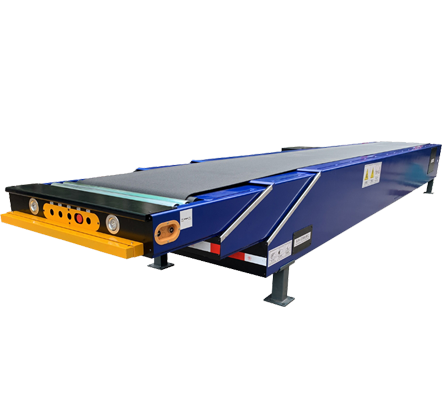
Extension length decides whether one unit serves the whole fleet or half of it. A 12-metre unit is a 40-foot tool; a 17-metre unit is a 53-foot dry van tool.
| Trailer or container | Interior length | Extension needed |
|---|---|---|
| 20 ft container | 5.9 m | 6 m |
| Pup trailer, box truck | 7.6 - 8.5 m | 8 - 9 m |
| 40 ft container, 40 ft HC | 12.03 m | 12 - 13 m |
| 45 ft container | 13.72 m | 14 m |
| 53 ft dry van | 16.15 m | 16.5 - 17 m |
Specify against the longest trailer you serve weekly, not the average, and leave 0.5 to 0.8 metres past the nose. A belt that stops exactly at the nose forces the operator to lean for every parcel in the last row.
A 17-metre unit does not remove manual work, it relocates it. The last 1.5 metres, plus the stack above and below belt height, stays human. What changes is time per trailer, because walking per parcel falls from six or eight metres to under two.
Fill rate is the share of trailer cube actually used, and the least measured number on a dock. Manual crews leave 10 to 15 percent of a 53-foot trailer empty because the last rows mean climbing over freight.
On a lane of 20 trailers a week, 90 percent fill wastes one trailer in ten — about 100 trailer-equivalents of paid capacity carrying air each year. A conveyor does not fix stacking discipline, but it delivers freight to the nose at a consistent height and keeps the load face square.
| Belt width | Best fit | Note |
|---|---|---|
| 500 mm | Small parcels, document bags | Lightest frame, single file |
| 600 mm | General parcel mix | Most common express choice |
| 800 mm | Mixed parcels with poly mailers | Allows side-by-side placement |
| 1000 mm | Bulk freight, tires, ULD work | Wider footprint, stronger frame |
At 0.5 m/s a parcel crosses 17 metres in 34 seconds and the belt buffers the flow; at 2.5 m/s it takes under seven and the belt becomes a queue arriving faster than the nose absorbs it.
Hydraulic lift looks like a comfort feature but is a reliability one. Trailer bed height moves with load while dock height does not, so 0 to plus or minus 5 degrees lets the belt end meet the working height. It also matters when the belt stops: on an incline a smooth poly parcel on PVC is held by friction alone, which is why a braked gear motor belongs in the specification.
| Parameter | Specification |
|---|---|
| Max telescopic length | 4 m to 17 m, customizable |
| Belt width | 500 / 600 / 800 / 1000 mm |
| Lifting angle | 0 to plus or minus 5 degrees, hydraulic |
| Load capacity | 60 kg/m distributed |
| Belt speed | 0.5 to 2.5 m/s, adjustable |
| Drive motor | SEW or Chengbang reduction motor with brake |
| Belt material | PVC / PVK / rubber |
| Frame, control | Powder-coated carbon steel; button panel, optional remote |
| Power, temperature | 380 V / 50 Hz or customized; -20 to +45 degrees C |
Read 60 kg/m carefully: it is a distributed load along the belt, not a licence to drop a single 60 kg item on one spot. Dense items concentrate stress on a short section. If your mix includes tool boxes, beverage cases or automotive parts, declare maximum item weight and footprint when specifying.
| Configuration | Crew per door | 53 ft cycle | Cost profile |
|---|---|---|---|
| Manual carrying and stacking | 3 to 4 | 90 to 120 min | Low capital, highest labour and injury exposure |
| Fixed boom or roller conveyor | 2 to 3 | 60 to 80 min | Limited reach, re-handling at the joint |
| Telescopic conveyor with lift | 2 | 40 to 55 min | Higher capital, one handling step removed |
The middle option is where many projects stop, and on 53-foot fleets that is usually a mistake: a boom that cannot enter the trailer turns a walking problem into a lifting problem at the joint. Telescopic extension exists to eliminate that transfer point.
Take four doors, three shifts, six days a week, each moving from three operators to two with the cycle cut by a third.
Line-haul rates keep pressure on per-trailer cost, pushing operators toward fill rate and cycle time rather than headcount, so equipment improving cube utilisation pays back through freight spend as much as wages. Labour availability in express hubs remains the binding constraint in most regions, and CE and ISO conformity papers are now routine in cross-border procurement.
Inside the equipment, the direction is integration rather than raw speed: conveyors are specified as the first metre of a sorting line, so interface height, control signals and handoff matter as much as extension.
Planning a dock upgrade in 2026?
WINDA builds belt telescopic conveyors from 4 to 17 metres with 500 to 1000 mm belts, hydraulic lift and SEW or Chengbang braked drives. Send your trailer mix and parcel profile and we will size extension and width for the lane.
Email: info [at] zowinda [dot] com | WhatsApp: +86 186 2085 0485 | Belt Telescopic Conveyor
Related: Telescopic Conveyor Trends 2026, Linear Cross Belt Sorter, Express Envelope Sorter.
Sorter
Wechat QR code
wechat number:Copyright © 2022-2023 Winda, inc. All rights reserved