

Every parcel-sorting conversation in 2026 starts with throughput records, yet the fastest-growing and most awkward category in e-commerce logistics is the opposite of a parcel: the express envelope. Light, floppy, label-critical and ordered in relentless volume, small flats jam machines designed to push boxes. The WINDA WDA-ES-5000 Auto Express Envelope Sorting Machine was engineered for this category: 5,000 envelopes per hour, 99.5% accuracy and a roller-based divert that treats a paper mailer gently enough to arrive presentable.
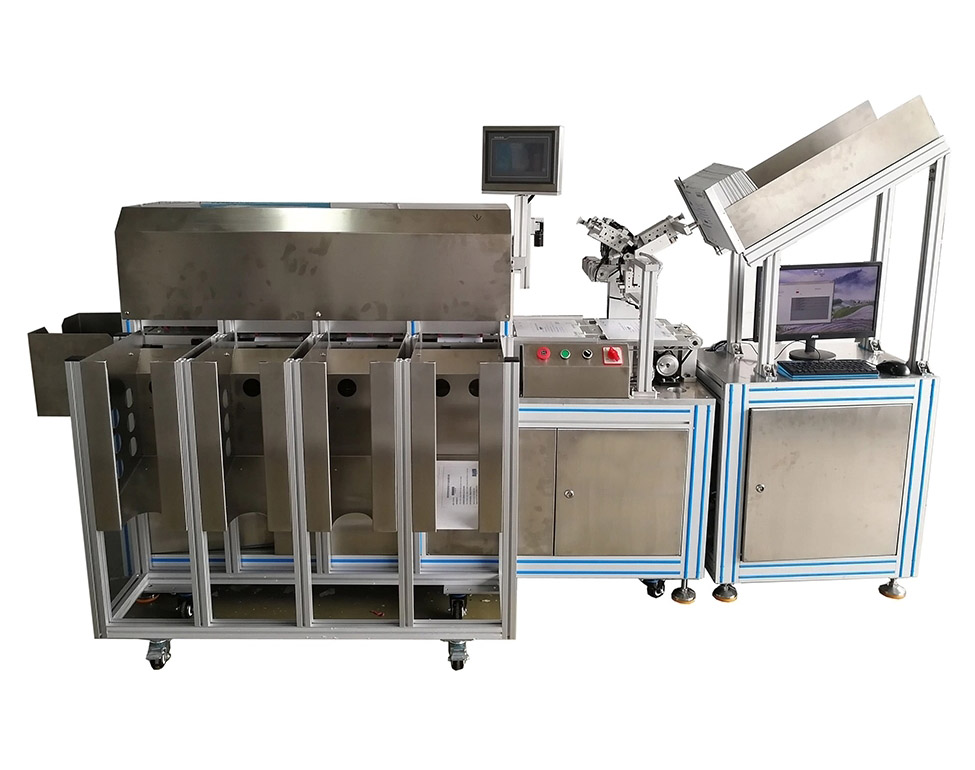
The machine automates a flow courier stations still run by hand: rotary suction feeding singulates each envelope, an industrial-grade barcode recognizer reads the shipping label, and a roller-type grading system drops it into one of eight collection boxes. Envelopes with unreadable or unknown codes divert automatically into an elimination box for manual review - the line never stops.
A standard parcel sorter handles a 23-gram mailer badly in three ways. Singulation: envelopes stick together, and a friction feeder tuned for boxes doubles them or spins them. Identification: a small, curved or glossy surface gives a fixed scanner one brief chance to read. Diversion: a pusher arm built for rigid cartons can crease a padded mailer, turning a delivered order into a return.
The WDA-ES-5000 answers each with mechanism, not software tuning. Rotary suction feeding presents envelopes one at a time with a stable gap; a servo motor drives a synchronous belt for precise, gentle transport; and the roller-type grading system re-directs by rolling rather than striking, so the envelope leaves in the condition it entered. Unglamorous engineering choices - and exactly why this category exists as a separate product line.
| Parameter | WDA-ES-5000 Auto Express Envelope Sorting Machine |
|---|---|
| Sorting speed | About 5,000 envelopes per hour |
| Sorting accuracy | 99.5% |
| Collection boxes | 8 sets, freely configurable by sorting category, quantity customizable |
| Identification | Industrial high-speed barcode recognizer; camera recognition upgradeable on demand |
| Feeding | Rotary suction, material box height about 600 mm; servo motor + synchronous belt transmission |
| Divert system | Roller-type grading, no damage to envelopes |
| Control system | PC control, real-time per-box receiving quantity display |
| Dimension / Weight | L2600 x W1500 x H1600 mm, about 500 kg |
| Power | AC 220V, 50/60 Hz, about 2 kW |
In a manual station, an envelope with a damaged code interrupts a person every time; at 5,000 envelopes per hour, even a 2% unreadable rate means 100 interruptions per hour if exceptions flow into the main line. The WDA-ES-5000 isolates that noise: unreadable and unknown codes route to the elimination box automatically, one operator reviews them in batches on a schedule, and the main flow holds its full rate. Tracked over the first months, the elimination rate typically falls - the per-box quantities the PC control records expose systematic upstream causes that were previously invisible.
Industry attention stays fixed on high-speed cross-belt and swivel-wheel installations, but the volume story includes a steady expansion of the small-flat segment: document envelopes, garment mailers, cosmetics, small accessories. Courier networks that once sorted this flow at staffed tables are converting to compact automated sorters; the purchase driver is labor availability and mis-sort cost. A 5,000-per-hour machine with a customizable eight-box layout matches a typical station's zoning without a parcel line's footprint or budget.
That economics also changes the automation conversation. Full automation used to be a large-facility privilege; at this machine class it is now the entry point, which is why singulation and exception-handling design now sit at the center of buying criteria.
For comparison across product classes, see our envelope sorter outlook, automated parcel sorter and card sorter coverage.
The WDA-ES-5000 turns a labor-intensive envelope table into a fully automated 5,000-per-hour sorting cell with 99.5% accuracy and customizable zoning. Tell us your envelope mix, daily volume and destination zoning, and we will configure the right collection-box layout for your site.
Contact WINDA: info@zowinda.com | Product page: Auto Express Envelope Sorting Machine WDA-ES-5000
Sorter
Wechat QR code
wechat number:Copyright © 2022-2023 Winda, inc. All rights reserved