

A label-and-sort station is no longer an accessory at the end of a food-packaging line. In 2026 it is where three obligations collide: the label must match the pack, the material must match the recycling stream, and the weight must match the declared fill. The Labeling & Sorting Machine for Baking Tray from WINDA was built for that intersection - it reads, weighs and diverts picnic boxes, takeaway containers and lids at 9,000 to 18,000 pieces per hour.
Ten years ago a mislabelled lunch box was a complaint. Today it is a withdrawal event:
Commercial machines in this segment run four inspections in parallel and fuse the results into a single divert decision.
| Check | What it catches | Practical limit |
|---|---|---|
| Label presence and position | Missing, skewed, double or wrongly placed label | Needs backlight or angled light on clear film |
| Code reading (OCR / OCV) | Wrong lot or date code, unreadable print, wrong SKU | Print contrast must stay above roughly 0.4 |
| Material and colour check | PS lid in a PP stream, coloured parts in a natural stream | Vision handles colour; clear-on-clear needs NIR |
| Weight verification | Short fill, double pack, missing insert | Dynamic weighing needs a settle zone |
The four answer different questions and no sensor replaces another: colour vision cannot split two clear polymers, load cells cannot spot a label on the wrong face, OCR cannot detect a short fill. One check alone is a conveyor with a camera, not a verification station. Placement matters too - verify after label application, and keep the reject divert within one conveyor pitch of the inspection point.
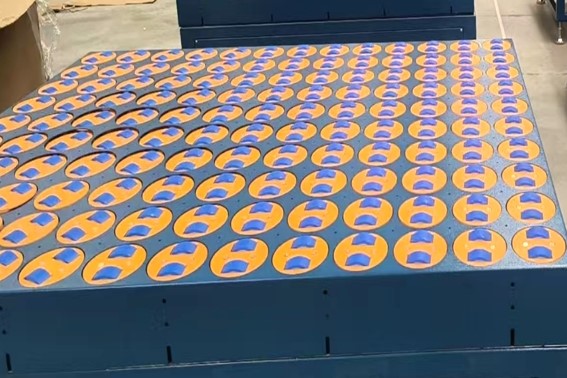
Almost every underperforming installation shares one mistake - a single reject chute, into which everything that fails any check lands. The operator learns nothing, and maintenance cannot tell a camera fault from a real defect. Four bins is the 2026 standard.
| Bin | Content | What the count tells you |
|---|---|---|
| Good product | All four checks passed | Yield - the number on the shift report |
| Label fault | Presence, position or code failure | Applicator drift, print head wear, film tension |
| Material fault | Wrong polymer, colour or foreign object | Upstream mix, uncleared moulding changeover |
| Weight fault | Fill or count deviation | Filler drift, insert miss, moisture pick-up |
Separated bins turn the reject stream into a diagnostic instrument: when label faults rise from 0.3 to 1.8 percent in one shift, the owner knows which subassembly to inspect. Cheapest quality system available, and it costs four chutes.
Take a plant at 16,000 pcs/h across three SKU families, two changeovers per shift, three shifts. A 3-minute changeover sounds trivial until counted: six a day is 18 minutes, plus ramp-down and ramp-up around each, realistically 35 to 45 minutes lost - roughly 9,000 to 12,000 pieces daily on one line. A machine needing 20 minutes instead of 3 loses over an hour and a half a day, usually the difference between one and two shifts of capacity. Accuracy reads the same way: at 16,000 pcs/h one tenth of a percent is 128 wrong packs a shift, so where tolerance is zero the false-reject rate matters as much as the escape rate.
The PLC and touchscreen count each divert category by shift and recipe, keep fault history and warn on drift. That data has a second life: when a converter must declare the purity of a recycled PP stream, a per-shift material-fault count is the only defensible evidence they own. So check for CSV or API export of the counters - a touchscreen that cannot hand numbers to a spreadsheet turns an audit asset into a screenshot.
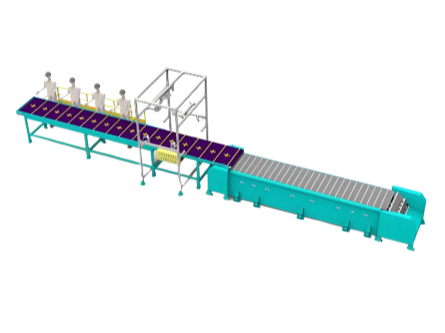
| Parameter | Value |
|---|---|
| Throughput | 9,000 - 18,000 pcs/h |
| Belt speed | 0.8 - 1.2 m/s, adjustable |
| Container size range | 50 x 50 mm to 500 x 500 mm, 99.9 percent accuracy |
| Changeover | About 3 minutes between products |
| Control | PLC plus touchscreen HMI, recipes, fault warning |
A supplier who answers all five with numbers is selling a verification station. One who answers three is selling a conveyor with a camera.
Three directions are clear from machines now shipping. Inspection is moving from fixed thresholds to trained models, which is what makes classification work on recycled material where batch variation defeats thresholds. Sensor fusion is becoming standard rather than premium - vision, weight and NIR in one decision layer - and the data layer is opening up, because converters are now asked for evidence they never produced before.
The Labeling & Sorting Machine for Baking Tray shows what a 2026 station looks like: 9,000 to 18,000 pcs/h, 0.8 to 1.2 m/s, containers from 50 x 50 mm to 500 x 500 mm, 3-minute changeover, closed food-grade frame. What separates a good installation from a mediocre one is not the specification but three decisions: are all four checks fitted, are rejects separated, does cleaning fit inside a shift. See also AI vision in baking tray sorting and single-piece separation systems.
Specifying a label-and-sort station for 2026?
Send your SKU mix, target throughput and container dimensions. We will return a configuration with the check set, bin layout and changeover sequence for your line.
Email: info [at] zowinda [dot] com | WhatsApp: +86 186 2085 0485
Sorter
Wechat QR code
wechat number:Copyright © 2022-2023 Winda, inc. All rights reserved