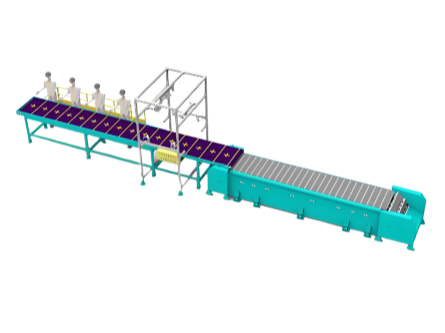

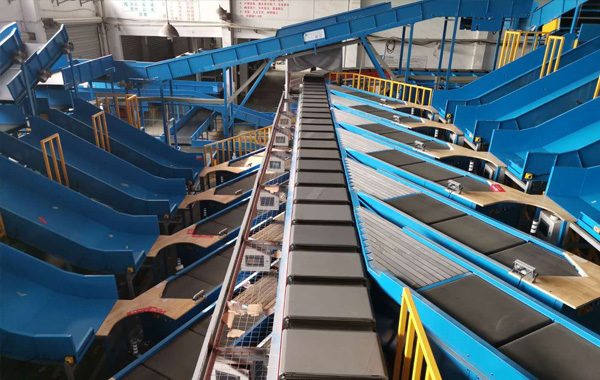
Circular Cross-Belt Sorter | 12000-24000 pcs/h High-Throughput Sorting System
Professional Sorting Solution for Express Logistics & E-commerce Distribution Centers
24,000
pcs/h Max Throughput
99.92%
Sorting Accuracy
200-400
Sorting Chutes
360 deg
Circular Loop Track
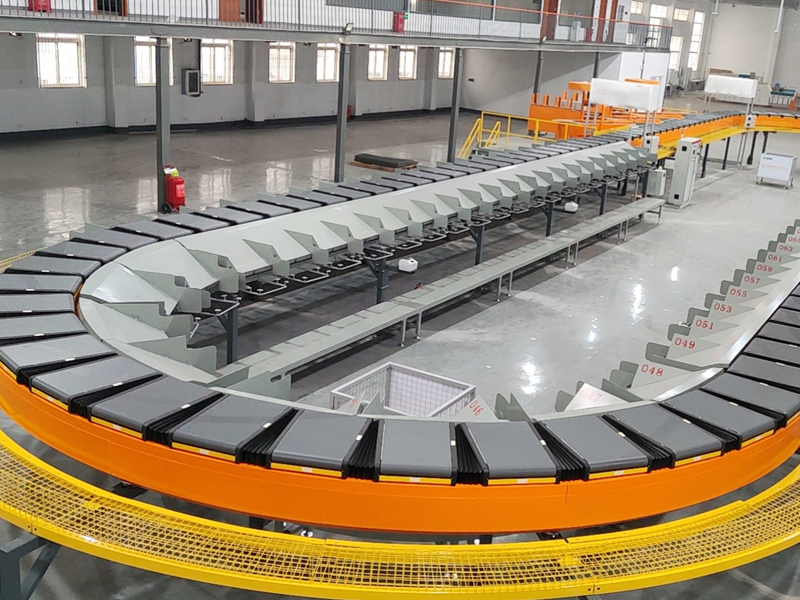
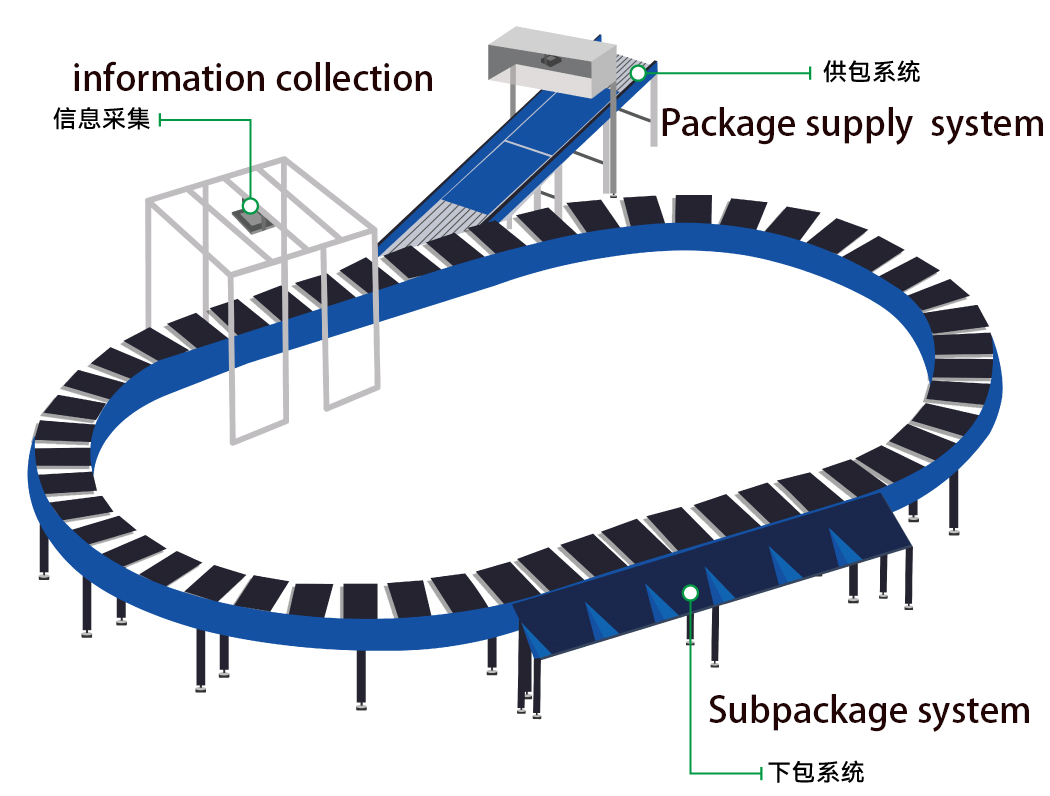
The Cross Belt Sorting Line is a high-performance automated sorting system featuring a circular closed-loop track design that enables continuous, non-stop operation of sorting trolleys. Unlike traditional linear sorters limited by unidirectional transmission, our cross-belt sorter adopts a 360-degree loop architecture, delivering up to 3.7x higher throughput than conventional solutions.
This system is specifically engineered for express logistics hubs, e-commerce distribution centers, airport baggage handling facilities, and manufacturing warehouses requiring high-volume, high-accuracy parcel sorting. The integrated DWS (Dimension, Weight, Barcode) recognition system completes 3D modeling and information identification within 0.2 seconds per item.
360-deg closed-loop track enables continuous trolley operation. Supports double-layer or triple-layer vertical stacking, increasing warehouse space utilization by up to 40%.
High-speed cameras (300 fps) + LiDAR complete 3D modeling in 0.2s. Deep learning algorithms handle irregular parcels with 99.92% sorting accuracy.
5 GHz wireless bridge with FHSS technology. Packet loss rate below 0.001% even with 200 concurrent trolleys. Wiring-free deployment cuts installation time by 80%.
Machine learning algorithms adjust trolley travel paths in real-time to minimize empty running rate. Parallel operation supports 200-400 sorting chutes simultaneously.
Simultaneous recognition of barcodes, QR codes, and RFID tags. Field-tested mis-sorting rate reduction of 82% for major express delivery enterprises.
Scalable architecture allows incremental capacity expansion. Custom configurations available for cold-chain logistics (low-temp resistant) and pharmaceutical industry (sterile modules).
| Parameter | Specification |
|---|---|
| Product Name | Cross Belt Sorting Line |
| Max Throughput | 12,000 - 24,000 pieces/hour |
| Sorting Accuracy | 99.92% |
| Sorting Chutes | 200 - 400 chutes (customizable) |
| Track Type | Circular 360-deg Closed Loop |
| DWS Recognition Time | 0.2 seconds / item |
| Weighing Accuracy | within +/-5 grams |
| Communication Protocol | 5 GHz Wireless Bridge (FHSS) |
| Power Supply | 380V / 50Hz (or customized) |
| Operating Temp | -20 degC to +45 degC |
| Certification | CE / ISO9001 |
High-speed sorting for SF Express, YTO, STO, ZTO networks. Handles peak volumes during Double-11 shopping festivals.
B2C order processing time reduced from 4 hours to 45 minutes. Ideal for JD.com, Taobao, Amazon fulfillment centers.
Baggage handling and air freight container sorting. Deployed at Beijing Capital International Airport Terminal 3.
Finished goods conveyance from production lines to shipping areas. Used by Haier Jinan Factory for home appliance sorting.
Low-temperature resistant sorting trolleys for frozen food and pharmaceutical distribution centers.
Sterile sorting modules compliant with GMP standards. Traceable handling for medical supplies and pharmaceuticals.
Q: What is a cross belt sorting line and how does it work?
A: A cross belt sorting line is an automated material handling system where individual sorting trolleys, each equipped with a small conveyor belt (the "cross belt"), travel along a circular or oval track. When a parcel reaches its destination chute, the cross belt activates to discharge the item laterally while the trolley continues moving. This design enables continuous, high-throughput sorting without stopping the main carrier.
Q: What is the difference between a cross belt sorter and a linear sorter?
A: Linear sorters have a maximum throughput of ~10,000 pieces/hour due to unidirectional transmission limits. Circular cross-belt sorters overcome this with a 360-deg closed-loop track, achieving 12,000-24,000 pieces/hour. Additionally, cross-belt systems support 200-400 simultaneous destination chutes versus typically under 100 for linear designs.
Q: How does the DWS (Dimension, Weight, Scan) recognition system work?
A: Our integrated DWS system uses high-speed cameras (300 frames/second) combined with LiDAR sensors to capture 3D measurements and barcode data in just 0.2 seconds per parcel. Deep learning algorithms handle irregular shapes (soft packs, envelopes, cylinders) with 99.92% accuracy. Dynamic weighing compensation keeps error within +/-5 grams.
Q: What is the typical lead time for ordering a cross belt sorting line?
A: Standard configuration models ship within 25-40 working days. Fully customized systems (special chute count, cold-chain modules, sterile design) require 40-60 working days. We maintain stock of popular configurations for faster delivery when needed.
Q: Can the system be expanded after installation?
A: Yes. The modular architecture supports incremental expansion -- you can add more sorting trolleys, additional chutes, or upgrade to multi-layer stacking as your business grows. Wireless communication means no rewiring is needed for most expansions.
Q: Do you provide installation and training services?
A: Yes. Each unit includes detailed installation manuals, video tutorials, and remote video technical support. On-site installation supervision and operator training are available at additional cost for international projects. Our engineering team provides lifetime technical consultation.
Contact us today for a free quote, CAD drawings, or factory visit arrangement. Our engineering team responds within 24 hours.
Sorter
Wechat QR code
wechat number:Copyright © 2022-2023 Winda, inc. All rights reserved