

Regional mail and parcel hubs face pressure national networks rarely feel: volumes fluctuate hourly, footprints are tight, and labor is scarce. In 2026 the machines winning these contracts are not giant loop sorters but compact, single-operator linear systems built around machine vision. The WINDA Mail Sorting Machine WDA-MS-6000 is a representative example: a 14.2-meter vision sorter rated at 5,000 pieces per hour, run by one person.
Sorting headlines are dominated by cross-belt loops handling 20,000-40,000 items per hour. Yet most of the world's sorting sites are not megahubs: postal operators run regional processing centers, courier franchises run city depots, and e-commerce sellers run their own fulfillment corners. For these sites, a machine demanding 60 meters of hall space and a dozen operators is the wrong tool - and the WDA-MS-6000 was engineered for exactly this gap. Its envelope is L14,200 x W1,980 x H1,650 mm, a straight line that fits a standard workshop bay or alongside existing conveyors. Rated power is about 5 kW on AC 220 V with 6 bar compressed air as the only auxiliary utility, so it runs on infrastructure most sites already have. When energy costs and installation lead time decide purchases as much as list price, this modest footprint is a genuine commercial advantage.
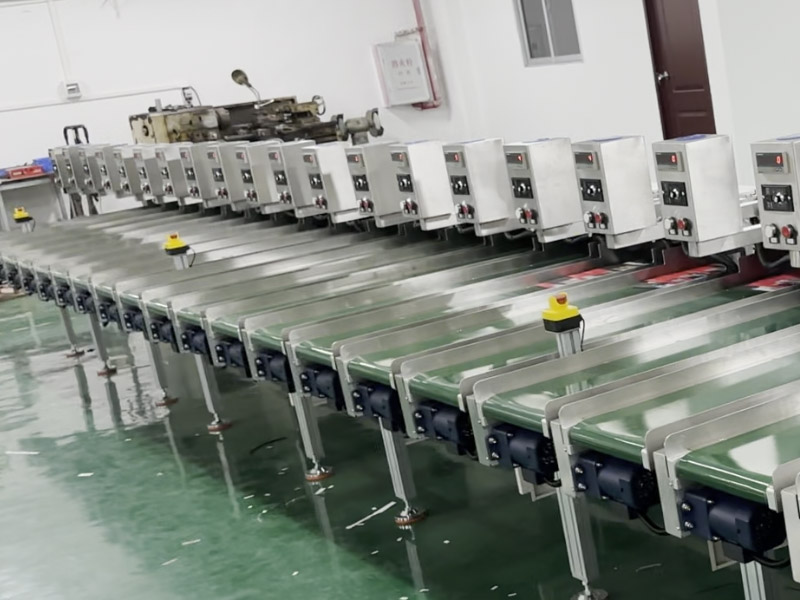
The defining technical shift this year is that intelligent scanning and recognition - once the expensive, fragile part of a sorter - has become the dependable part. The WDA-MS-6000 uses machine vision to identify mail and packages by address or route and sorts them automatically. Three developments explain why:
Recognition speed has caught up with transport speed. At 5,000 pcs/h the vision system gets a generous reading window per item. Modern engines decode barcodes, read printed addresses, and match route codes within that window, so the machine sustains a high recognition rate rather than merely peaking at one. Training no longer requires engineers. Recognition models in 2026 arrive pre-trained on address formats, label styles, and envelope types; when a new mail class appears, operators retrain through the software interface. The interface has become icon-based. Route changes and chute assignments are configured visually in the PC-based software, so a site can re-map its sorting plan between shifts - vital for postal operations whose volume mix changes seasonally.
At the heart of the machine sits a PC with a motion control card in a PCI slot, wired to the I/O board in the electric control box. This shapes uptime and lifecycle cost more than any single spec. Because all operation, parameter setting, and manual moves run through the industrial computer behind the left door panel, there is no proprietary controller with sealed firmware: diagnostics are transparent, parameter changes are immediate, and integration with upstream DWS equipment happens at the PC layer - turning vendor-lock-in service calls into locally solvable work.
Safety is deliberately redundant: a main power switch in the electric control box, a separate power switch on the right side, a start button that recovers operation after faults, and multiple emergency stops along the line - the layout that makes one-person operation defensible.
| Parameter | Specification |
|---|---|
| Product Model | WDA-MS-6000 |
| Overall Dimensions | L14,200 x W1,980 x H1,650 mm |
| Weight | 3,200 kg |
| Power Supply | AC 220 V, 50/60 Hz |
| Rated Power | About 5 kW |
| Air Source | 6 bar |
| Motion Control | PC + motion control card |
| Operating Speed | 5,000 pcs/hour (configurable) |
| Material Spec | Standard mail seal |
| Operators Required | 1 person |
| Software | PC-based control software (icon-based desktop) |
Two numbers carry the most economic weight. The 5,000 pcs/hour rating is deliberately "configurable" - throughput can be tuned to match upstream feeding, which protects accuracy and cuts jam-clearing interruptions. And "1 operator" is the staffing model: one induct worker loads standard mail seals while vision and motion control handle the rest. Sites that previously assigned three or four people to manual sorting describe the transition as a 300% efficiency gain.
Postal service. National sorting centers use WDA-MS-6000-class machines as regional workhorses for the standard flats and seals that dominate daily mail mix - each regional facility still needs to break down and re-route mail daily.
Express delivery. Courier depots face inbound volume in waves, and every mis-sorted parcel becomes a second delivery attempt. A single-operator vision sorter at the depot gate cleans the stream before it reaches couriers, cutting failed-delivery costs.
Logistics and e-commerce. Distribution centers value flexible configuration for different package sizes and sorting requirements, while fulfillment operations use compact sorters to separate returns, outbound orders, and replenishment flows - on 220 V power, inside a warehouse that could never host a cross-belt loop.
Labor scarcity is structural. Sorting is repetitive standing work with high turnover; the "1 operator" specification is the core selling proposition of this machine class, and buyers increasingly calculate ROI from avoided labor hours rather than throughput alone. Vision is migrating down-market. Recognition technology exclusive to megahub equipment five years ago is now standard on compact machines. Open architectures are preferred. Buyers ask whether a sorter can log data, integrate with WMS software, and be diagnosed without vendor lockdown - PC-plus-motion-card designs answer yes. Configurable throughput beats headline numbers. A stable 5,000 pcs/h with high recognition and low jam frequency often outperforms a nominally faster machine.
Before signing, evaluate five questions: Does the recognition rate hold on your realistic mixed stream? How does accuracy respond at below-maximum throughput? Are route changes handled in minutes? What does installation and training include? And what is the spare-parts commitment over ten years? The WINDA package covers on-site installation, 8-16 hours of operator training, maintenance certification, a 12-month warranty, a 24/7 support hotline, and 10+ years of spare parts supply.
The 2026 market does not reward buying the biggest sorter; it rewards buying the right one. For regional postal centers, express depots, and e-commerce fulfillment operations, the Mail Sorting Machine WDA-MS-6000 is the current state of the art in compact automated sorting: machine vision recognition, an open PC architecture, 5,000 pieces per hour of configurable throughput, and a one-operator staffing model that attacks the largest cost line in mail handling. Details: Mail Sorting Machine product page; compare the WDA-ES-5000 envelope sorting outlook and the single-piece separation system.
Sorter
Wechat QR code
wechat number:Copyright © 2022-2023 Winda, inc. All rights reserved