

As smart cards evolve from simple tokens into multi-application payment, identity and transit credentials, personalization has become the highest-value step of the card production chain. In 2026, the machines that write data and keys onto each card are being redefined by dual-interface convergence, stronger key security and vision-driven quality control. The WINDA IC Card Personalization Machine, built around 32 contact and 12 contactless stations, shows how this shift is reshaping expectations for issuers and service bureaus worldwide.
Blank card manufacturing is a commoditized process: printing, laminating and punching lines are widely available and highly automated. What separates competitive producers today is not how fast they make a blank card, but how fast, safely and verifiably they turn it into a live credential. Personalization is where chips are initialized, EMV data loaded, keys injected and cardholder data engraved.
This stage carries the strictest compliance requirements of the whole line. Payment schemes demand certified key management; government programs require audit trails for every card; transit operators tolerate no duplicate serial numbers. The market now asks for machines that write data correctly, prove it and protect it. That is the design brief behind the WINDA IC Card Personalization Machine: 4,000 to 5,000 cards per hour, integrated PC and PLC control, and a high-precision CCD vision system.

The defining hardware trend of 2026 is the collapse of the boundary between contact and contactless personalization. Banks increasingly issue dual-interface cards that must be initialized over both ISO 7816 contacts and ISO 14443 air interfaces in one pass; residence permits, social security and transportation cards follow the same pattern. Running two separate lines doubles handling and introduces serialization mismatches between chip domains.
The WINDA architecture addresses this directly: 32 contact stations compliant with ISO 7816 work in parallel with 12 contactless stations compliant with ISO 14443, so each card receives chip initialization and antenna coupling tests in one flow. A banking batch and a transit batch can run back to back without retooling, thanks to a modular design that supports tailor-made configurations. In an era of shorter, more fragmented issuance campaigns, that changeover agility is often worth more than raw peak speed.
Card personalization is, at its core, a security operation. Every card written carries cryptographic keys whose compromise would be far more damaging than any production delay. In 2026, issuers and certification bodies are pushing security harder than ever: hardware security modules must sit between data preparation and the writer; key diversification must be verifiable per card; and miswritten cards must be logged and traceable end to end.
The WINDA machine uses integrated PC plus PLC control, keeping the data path and the mechanical path under one supervisory system and producing a coherent event log for every card. Windows 7 and Windows 10 compatibility lets integration teams connect established data-preparation environments and HSM middleware without rewriting their issuance software. For organizations preparing audits under payment scheme or national identity regulations, this traceability is the condition of doing business.
A clear 2026 trend is the migration of quality control from end-of-line sampling to per-card, in-line verification. A high-precision CCD camera inspects each card as it exits the stations, checking that the correct chip is present, that printed personalization matches the written dataset, and that surface defects are caught before cards reach the issuing envelope.
The economics are persuasive. A mispersonized card discovered by a cardholder costs far more than one rejected in-line: courier cost, reissue cost and the reputational damage of a failed first activation. By rejecting defective cards automatically at station level, vision-guided personalization converts quality from an inspection cost into a data stream that continuously tunes the line. At 4,000 to 5,000 cards per hour, only machine-speed inspection scales.
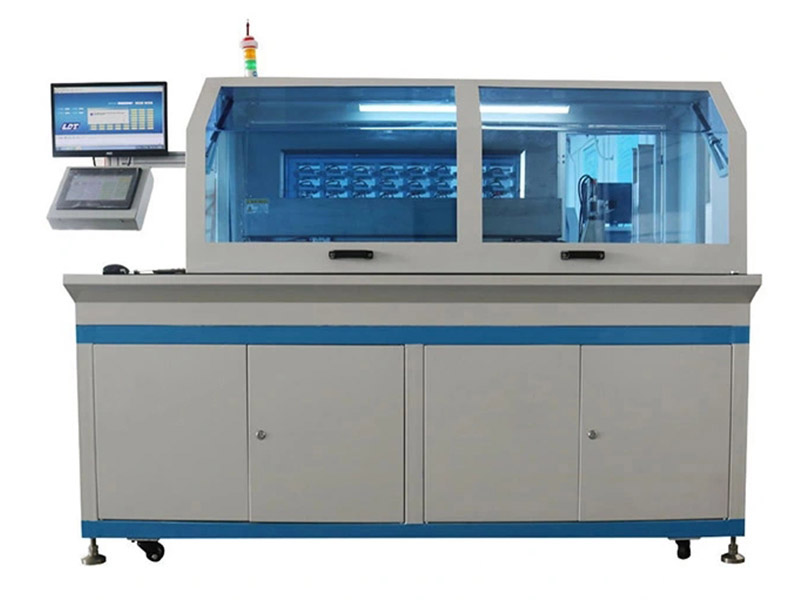
| Parameter | Specification |
|---|---|
| Productivity | 4,000 to 5,000 PCS/h (depends on the data) |
| Contact stations | 32 stations, ISO 7816 compliant |
| Contactless stations | 12 stations, ISO 14443 compliant |
| Control system | PC + PLC integrated control |
| Vision system | High-precision CCD camera with software control |
| Operating system | Windows 7 / Windows 10 |
| Card types | Banking, social security, resident, dual-interface, transportation, loyalty |
| Power supply | 6.5 KW, AC 220 V, 50/60 Hz |
| Weight | 700 Kg |
| Customization | Modular design, tailor-made configurations |
Banking remains the anchor application. EMV migration is still accelerating across parts of Africa, South Asia and Latin America, and every newly issued payment card must be personalized under scheme rules. The 4,000 to 5,000 cards per hour class fits the batch sizes of regional banks and service bureaus that are too large for desktop machines and too variable for mass-personalization centers.
Government programs form the second pillar. National ID, resident permits and social security projects demand the same cryptographic discipline as payments, plus strict configuration control; the modular design allows extra stations or engraving modules as volumes grow. The third pillar is urban mobility and loyalty: transportation and loyalty cards are issued in seasonal campaigns, where running contactless-dominant batches through the 12 ISO 14443 stations keeps turnaround short and unit costs predictable.
Three forces are shaping purchase decisions this year. First, credential proliferation: the discipline that served payment cards now applies to campus, healthcare and IoT identity tokens, pushing buyers toward flexible modular machines. Second, nearshoring: more issuers want card production inside their own region, favoring compact 6.5 KW-class equipment. Third, data sovereignty rules require key injection under local control with complete audit logs, strengthening the case for integrated PC + PLC architectures.
Buyers are also scrutinizing total cost of ownership rather than sticker price. Throughput per operator, changeover time, consumable usage and integration cost dominate 2026 procurement scorecards. A 700 Kg machine that one technician can operate and maintain, with widely supported Windows compatibility, scores well on every criterion versus older proprietary platforms.
Organizations planning a 2026 investment should begin with a data audit: how many card programs, what chip platforms, which key management policies. That audit determines the station mix, since dual-interface-heavy portfolios justify the full 32-contact plus 12-contactless configuration while contactless-only programs can start smaller. Second, plan integration early: defining event log formats and rejection rules before installation avoids months of tuning. Third, budget for vision from day one; retrofitting inspection after a quality incident always costs more than specifying the CCD system at purchase.
Finally, choose a partner, not just a machine. Card programs evolve and chip platforms rotate. A supplier that delivers modular configurations and long-term spare support turns the personalization line from a fixed asset into a durable competitive capability.
In 2026 the personalization machine is no longer the quiet step at the end of the card line; it is the security boundary, the quality gate and the flexibility lever of the whole operation. With 32 ISO 7816 contact stations, 12 ISO 14443 contactless stations, 4,000 to 5,000 cards per hour, PC + PLC control and CCD vision verification, the WINDA IC Card Personalization Machine is engineered for the requirements banks, governments and transit operators are writing into their tenders this year. Producers who upgrade now will issue credentials faster, safer and at lower total cost.
Ready to upgrade your card personalization line?
Learn more on the IC Card Personalization Machine product page, or read the Linear Cross Belt Sorter 2026 outlook and Express Envelope Sorter 2026 outlook.
Contact WINDA for a tailored configuration and quotation: info [at] zowinda [dot] com
Sorter
Wechat QR code
wechat number:Copyright © 2022-2023 Winda, inc. All rights reserved