

Spec sheets list dozens of numbers, and buyers argue about the loudest one: throughput. On the WINDA Mail Sorting Machine WDA-MS-6000, the quietest line in the table may matter more: operators required: 1 person. A 5,000 pieces-per-hour sort line that one person can run is a different staffing model.
This 2026 analysis reads the machine through that lens: what one operator means per shift, why configurable speed changes scheduling, what 14.2 metres demand of an existing building, and what uptime economics decide.

Figure 1. The WDA-MS-6000: 14.2 metres of throughput, one operator station.
Manual flat-mail sorting runs at 300 to 600 items per hour per trained clerk, and accuracy slips past hour six. A ten-clerk bench sorting 5,000 pieces costs ten wages and a supervisor's attention. The WDA-MS-6000 sorts 5,000 pieces per hour with one operator whose job shifts from reading addresses to feeding, monitoring, and clearing jams.
Replacing a ten-person bench with one operator and one floating exception handler converts roughly eight full-time roles into machine capital. At fully loaded 2026 costs, that labor line alone funds the machine in 18 to 30 months - before counting the accuracy gain. Our first examination covered its technology trajectory; this one covers the operating math.
"One person" maps to three duties:
The profile survives turnover better than manual benches.
The 5,000 pieces-per-hour rating is listed as configurable, and that word deserves planning attention. Mail volume is not flat: a regional postal facility may process 60 percent of daily volume in four hours. A configurable-speed sorter matches line speed to the arrival curve instead of forcing a fixed cadence that starves the infeed during lulls and backs it up during peaks.
Two rules follow. First, commission at several setpoints against your real mail mix and record jam behavior at each; feed quality, not motor capacity, defines the usable ceiling. Second, write the setpoints into the shift plan: a 3,500 piece-per-hour setting with one operator often outperforms a nominal 5,000 setting that needs a second person chasing the infeed.
The line runs L14,200 x W1,980 x H1,650 mm at 3,200 kg. Length is the constraint: fourteen point two metres plus staging and outlet clearance reserves 18 to 20 metres of straight wall - far less than the 40 to 60 metres a cross-belt loop demands.
Utilities are modest: AC 220V at roughly 5 kW plus 6 bar air - line items, not projects, if your building lacks them. The straight linear frame spreads floor load along a shallow strip; most reinforced slabs carry 3,200 kg over 14 metres without reinforcement.
At 5,000 pieces per hour, an hour of standstill wastes the throughput plus the labor scheduled around it, and the backlog pushes already-tight SLAs.
| Failure driver | Design answer on the WDA-MS-6000 | What to verify at FAT |
|---|---|---|
| Jams from mixed mail | Vision-based orientation checks, controlled spacing | Jam rate on YOUR dirtiest sample mail |
| Control faults | PC + motion control card: standard parts, swappable in hours | Spare-parts list, card availability |
| Pneumatic drift | 6 bar supply with filtration defines actuator life | FRL spec, compressor duty sizing |
| Software dependence | Icon-based interface, restorable parameters | Timed recovery after a PC failure |
The PC-plus-motion-control-card architecture is an uptime asset because it is ordinary: an IT technician swaps a failed PC same-day, while proprietary controllers quote weeks for board repair. Price one year of consumables and one simulated PC failure before comparing prices.
| Specification | WINDA WDA-MS-6000 |
|---|---|
| Operating speed | 5,000 pieces per hour, configurable to mail mix |
| Operators | 1 person |
| Footprint | L14,200 x W1,980 x H1,650 mm, 3,200 kg |
| Power and air | AC 220V, 50/60 Hz, about 5 kW; 6 bar air |
| Control | PC + motion control card, icon-based software |
| Media | Standard mail seals, vision-assisted handling |
Where volume outgrows one line, a second machine beside the first scales capacity without redesigning the building.
The common thread is 15,000 to 40,000 pieces per day - too much for manual benches, too little for a 40-metre loop sorter. For the small-hub variant, see our express envelope sorter analysis.
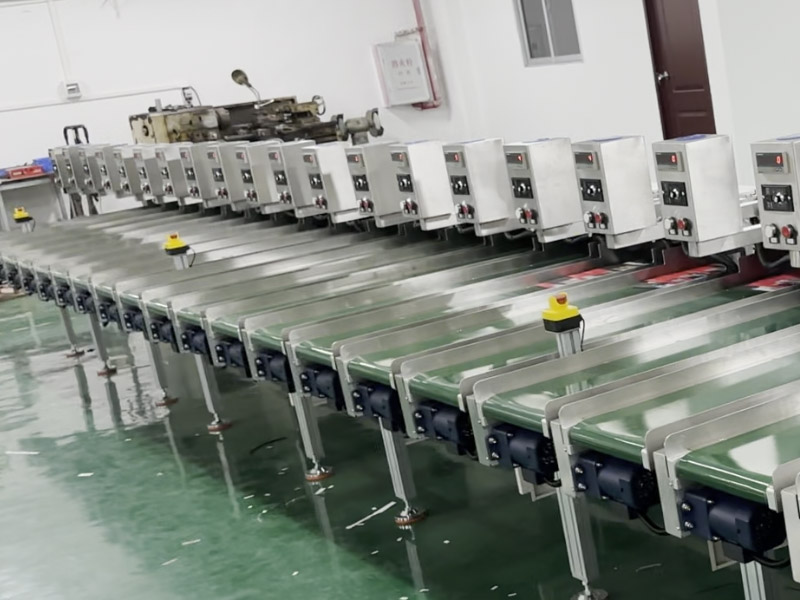
Figure 2. Outlets and the single operator station: the whole line is one person's workspace.
Take a regional operation sorting 30,000 flats per day. Manual: ten clerks per shift at 450 pieces per hour, meeting volume only with peak overtime. Automated: one WDA-MS-6000 clears 30,000 pieces in six operating hours; one operator per shift plus a shared exception handler covers the line; peak days extend the schedule by config, not headcount.
The labor delta of seven to eight roles per line funds the machine in 18 to 30 months at typical wage levels. Accuracy compounds the case: manual benches mis-sort 1 to 2 percent of items, each corrected downstream at 15 to 20 seconds; machine-vision sorting holds errors an order of magnitude lower, converting into fewer redelivery attempts and complaints.
Sortation decisions in 2026 reward buyers who read the staffing column, floor plan, and recovery procedure as carefully as the throughput line - and the WDA-MS-6000 was engineered for that reading.
Ready to size a mail sorting line for your facility? WINDA builds the WDA-MS-6000 and a full range of sorting automation, with configuration support for your mail mix and floor plan.
Contact us for a quotation: info [at] zowinda [dot] com | WhatsApp: +86 186 2085 0485. Full machine details on the Mail Sorting Machine product page.
Sorter
Wechat QR code
wechat number:Copyright © 2022-2023 Winda, inc. All rights reserved