
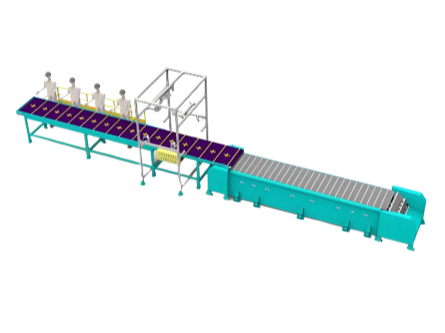
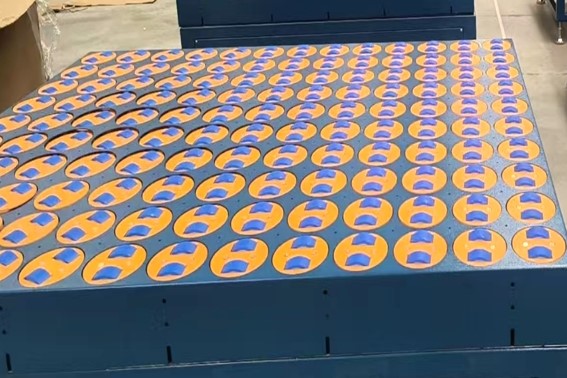
A sorting line can only be as fast as the flow fed into it. Upstream, parcels arrive in bulk - tipped from gaylords, pallets or carts in overlapping clumps. Downstream, induction lanes want a clean, evenly spaced, single file. The machine that bridges those two states decides whether a sorter ever reaches its nameplate rate. The Semi-Automated Bulk Singulator WDA-BS-7000 occupies that bridge: a patented system rated up to 7,000 parcels per hour with one or two operators.
Buyers evaluate sorters on read rates and destinations, then discover the real constraint at the front of the line. If parcels arrive two or three at a time, overlapped or on edge, the induction point starves the sorter no matter how many shoes or cross-belt carriers it has. Singulation is not a convenience; it is the maximum sustainable feed into the whole system.
There have historically been two answers. Manual singulation is cheap to install but expensive to run, and its rate falls with fatigue across a shift. A fully automated bulk singulator is fast but carries a large footprint and a high price tag that only very high-volume sites can justify. The WDA-BS-7000 was designed for the space between those two, converting bulk flow into a singulated stream without either a large labor bill or a capital line.
Framing the decision this way matters. The question is not whether the machine can singulate - it can - but whether a semi-automated cell is the right economic point for a site's volume profile. That is the 2026 question this article answers.
Choosing a singulation strategy is an exercise in trading capex against opex against floor space. The table below places the three options side by side on the variables that actually decide a purchase.
The semi-automated cell wins where volume is real but not continuous enough to amortize a full line, or where floor space is constrained and a compact unit fits where a large automation cell cannot. It is not the cheapest option on paper and not the fastest - but it is often the lowest total cost at mid-volume, because it removes the largest manual labor component without buying a machine that runs idle for half a shift.
| Option | Typical rate | Labor | Footprint / capex |
|---|---|---|---|
| Manual singulation | Low, declines with fatigue | High, several operators | Minimal / low |
| Semi-automated WDA-BS-7000 | Up to 7,000 PPH | 1-2 operators | Compact / mid |
| Fully automated bulk line | Very high | Station oversight | Large / high |
Up to 7,000 PPH is a conditional ceiling, not a shift average. It assumes a workable parcel mix, adequate feed from the induction table and an operator keeping pace. The useful number for a business case is a measured sustained rate with the site's own polybags and cartons, not the datasheet maximum.
The one-or-two operator design is more valuable than it first appears. It is a scheduling tool: one operator suits steady, uniform flow; a second is added for peak windows or mixed, irregular product. That flexibility lets a site scale labor to volume within the same footprint instead of buying a bigger machine for a few busy hours. It is the same right-sizing logic discussed in singulation and separation economics.
Write the operating point into the contract: sustained rate at a defined parcel mix, the operator count used, and the measurement window. Without those three, the 7,000 PPH figure is untestable.
Two hardware options change where the machine fits. Dual-lane feeding lets a single unit supply one induction lane or split load between two by smart-sensing available space. That turns one singulator into a shared resource for two downstream paths, which matters when a facility feeds more than one sorter or a sorter with two induction points.
The dumper option discharges gaylords, pallets or carts directly into the feed, raising feeding efficiency by removing a manual transfer step. Where parcels arrive in bulk containers, the dumper is often what makes the one-operator case realistic; without it, an operator spends the shift emptying containers rather than managing flow.
Both options should be evaluated on the inbound format actually used. A site receiving floor-loaded cartons values the dumper; a site receiving already-open totes may not. Specifying options against the real inbound profile avoids paying for capability that never runs.
Three programmable modes - fast automatic induction, slow automatic induction and manual pull - are selected on the touch screen. Treated as a feature list, that is unremarkable. Treated as a product-mix tool, it is central to throughput.
Fast automatic suits uniform standard parcels at high volume. Slow automatic gives fragile items and polybags gentler handling, reducing deformation and re-work at induction. Manual pull gives an operator maximum control over irregular shapes that automation would misread. Switching by product type means one cell handles a mixed catalog without a second machine.
The 2026 direction is toward lines that adapt to the parcel rather than forcing the parcel to adapt to the line. That theme runs through nameplate versus achievable throughput: the winning machines are those whose flexibility survives a real, mixed shift.
| Metric | How to measure |
|---|---|
| Sustained singulation rate | Defined window, actual parcel mix |
| Spacing consistency | Gap distribution at induction, not average |
| Operator count | Operators on shift at the measured rate |
| Mode changeover | Time to switch between the three modes |
Three forces favor the semi-automated cell this year. Labor availability keeps pushing mid-volume sites to remove manual singulation without committing to a full line. Parcel mix keeps diversifying as marketplace, direct-to-consumer and return flows converge, rewarding machines that switch mode by product. And buyers increasingly demand measurable service levels rather than brochure figures.
For the WDA-BS-7000 those forces align with the design: broad compatibility from polybags to boxes, a patented compact approach that fits constrained floors, one or two operators scaled to volume, and a touch-screen interface operators learn quickly. The machines that win evaluations will be those whose numbers are reproducible on the buyer's own floor.
That rewards suppliers willing to publish test conditions. Up to 7,000 PPH with one or two operators is a useful starting point; a witnessed run with the customer's parcel mix is the argument that closes the order.
The fastest way to decide is a witnessed run with your own parcel mix, recording sustained rate, spacing consistency and operator count together. Against those figures, the 7,000 PPH ceiling and the one-or-two operator design become a defensible business case rather than a comparison chart.
Related reading: our bulk singulation technology overview covers the platform, and our dock conveyor economics guide covers the upstream interface.
For a footprint review, a sample-run slot or a factory-direct quotation, contact WINDA at info [at] zowinda [dot] com - we will map the WDA-BS-7000 to your parcel mix and induction layout within one business day.
Sorter
Wechat QR code
wechat number:Copyright © 2022-2023 Winda, inc. All rights reserved