

The swivel wheel sorter has become the default choice for mid-size distribution centers that need real automation without the footprint, cost, and complexity of a full cross-belt system. In 2026, that middle market is being reshaped by one configuration: a compact DWS-integrated line with six sorting stations plus a dedicated NG exception station. WINDA's High-Efficiency Swivel Wheel Sorters (up to 12,000 pieces per hour, 99.95%+ accuracy, 50 g to 25 kg parcel range) show exactly where this segment is heading. Below we examine the 2026 trends behind this configuration, its best-fit applications, and why the 18-24 month payback profile is changing how regional operators justify automation.

Sorting economics changed between 2023 and 2026. Parcel volumes at regional hubs stopped growing in straight lines and started oscillating with e-commerce promotions, returns seasons, and same-day delivery pilots. A 30-to-40-chute cross-belt system is built for peak saturation; a six-station swivel wheel line is built for flexibility.
The deeper trend is that operators are no longer buying "a sorter" - they are buying a reconfigurable allocation problem. Six physical stations cover the destinations that absorb most of a regional hub's volume; everything else flows to the NG/overflow station for a second pass. This "peak capture, off-peak sweep" pattern is becoming the standard playbook for facilities handling 15,000 to 40,000 parcels per day.
The defining engineering trend of 2026 is not mechanical at all. Dimensioning, Weighing, and Scanning (DWS) has moved from a stand-alone upstream island into the data backbone of the sorting line. In the WINDA configuration, the DWS section feeds barcode, QR, and optional OCR recognition directly into the sorter's PLC layer, so every diversion decision is made while the item is still in motion.
Three practical consequences follow. First, item size (100 x 100 mm up to 500 x 500 mm) and weight (50 g to 25 kg) data flow into WMS, billing, and carrier manifest systems automatically. Second, exception classification becomes actionable: an unreadable barcode, an overweight item, and a fragile-flagged SKU are distinct NG categories, each routed to the dedicated NG station with its own handling instruction. Third, operators can replay a week of diversion logs to test whether a station should be re-purposed - far cheaper than buying new hardware.
Industry practice in 2026 treats the exception station as a first-class metric. A line that diverts 3% of items to a manual side table loses dwell time and the data trail with them. A dedicated NG station that captures unreadable, oversized, or problematic items without interrupting the main flow keeps the 99.95%+ accuracy meaningful - accuracy measured only on "clean" items is a vanity metric.
The 2026 trend is NG stations wired into the same SCADA/IoT layer as the primary line, so exception rates per station, hour, and carrier are trended automatically, and root cause surfaces in hours instead of weeks.
Cross-belt carriages carry items sideways; narrow-belt diverts with pop-up belts; the swivel wheel rotates to guide items off the main line with a smooth tangential nudge. For fragile electronics, cosmetics, premium retail goods, and padded envelopes, that difference matters: contact stress is lower, slide distances are shorter, and there is no carriage-to-chute drop to tune. As more hubs take on 3PL work mixing hard cases with soft goods, gentle handling is a major reason the swivel wheel keeps winning mid-range tenders.
Servo-driven wheel rotation and synchronous speed control between the conveyor and the divert angle also reduce mis-throws at high accumulation rates. With accuracy at 99.95%+ and errors roughly 99% lower than manual sorting, the mechanical ceiling is no longer the constraint; the constraint is upstream read rate, exactly what integrated DWS addresses.
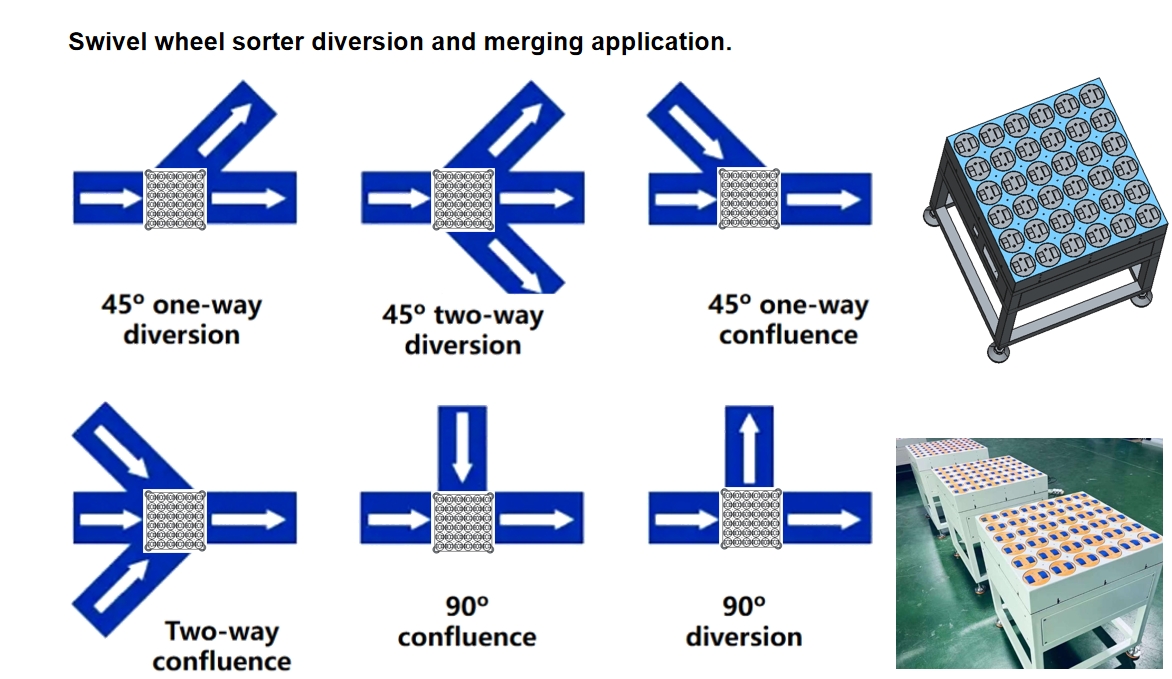
The strongest market signal of 2026 is financial, not technical. WINDA quotes 60-70% labor cost reduction, five times manual throughput, and an 18-24 month payback period. For a regional hub replacing a six-to-ten-person manual sort wall, the arithmetic is credible: labor savings alone typically cover depreciation, and exception-station data reduces the indirect costs (mis-sorts, claims, re-ships) that never appeared on the original spreadsheet.
The trend this reflects is "right-sized automation": instead of financing a 20,000 pieces/hour system against projected growth that may not arrive on schedule, operators deploy a compact line now and add stations or a second module later. Because the control layer speaks TCP/IP and standard fieldbus protocols, capacity expansion is a controls project rather than a rebuild.
| Parameter | Specification |
|---|---|
| Total Sorting Stations | 6 stations + 1 NG exception station |
| Sorting Capacity | Up to 12,000 pieces/hour |
| Item Size Range | 100 x 100 mm to 500 x 500 mm |
| Item Weight Range | 50 g - 25 kg |
| Sorting Accuracy | 99.95%+ |
| Conveyor Speed | 0.8 - 1.8 m/s adjustable |
| Recognition Technology | Barcode / QR Code / OCR optional |
| Power Supply | AC 380V 50Hz / 220V available |
| Labor Cost Savings | 60-70% reduction vs. manual |
| Payback Period | 18-24 months |
Four scenarios dominate deployments:
Regional e-commerce fulfillment. A single line covers the platform warehouse, the two main regional couriers, the returns processor, and the bulk/overflow destination - the exact profile this layout assumes.
Postal and courier last-mile branches. Where a national carrier aggregates parcels from rural offices, the swivel wheel's tolerance of soft, irregular, and padded items outperforms rigid sliding systems, and the NG station absorbs the poor label quality of low-volume origins.
3PL multi-client hubs. Client mixes change quarterly. Software-defined destination mapping lets the same six stations serve each quarter's roster without mechanical changes, and DWS data supports per-client billing directly.
Reverse logistics and returns centers. Returns arrive unlabeled, oversized, or damaged at far higher rates than outbound parcels; a dedicated NG station with categorized exception data turns chaotic intake into measurable triage.
Procurement teams in 2026 should pressure-test three points. First, read-rate transparency: ask for measured barcode/QR read rates on your sample parcels, not lab statistics - the accuracy ceiling is set upstream of the wheel. Second, NG station depth: confirm exception categories are configurable and the station reports into the same data layer as the primary line. Third, expansion path: verify that adding stations is a controls-level change, with connector documentation in writing.
WINDA supplies swivel wheel sorting systems with integrated DWS, 6+1 station configurations, and full data connectivity for WMS/ERP integration. Send us your daily parcel profile - volumes, size and weight distribution, and destination mix - and our engineers will return a layout proposal with capacity and payback estimates within 48 hours.
Email: info [at] zowinda [dot] com | WhatsApp: +86 186 2085 0485
Related reading: Linear Cross Belt Sorter 2026 Outlook | Single-piece Logistics Separation System | Product page: High-Efficiency Swivel Wheel Sorters (6+1 Stations)
Sorter
Wechat QR code
wechat number:Copyright © 2022-2023 Winda, inc. All rights reserved