

Most singulation projects are bought as machines and argued about as numbers. The rate looks convincing in a demo, and a year later the sorter downstream still cannot reach its rated throughput. The cause is always the same: nobody wrote down what the cell was supposed to deliver as data. This article turns it into a measurable specification, using the WINDA Single-piece Logistics Separation System as the reference platform.
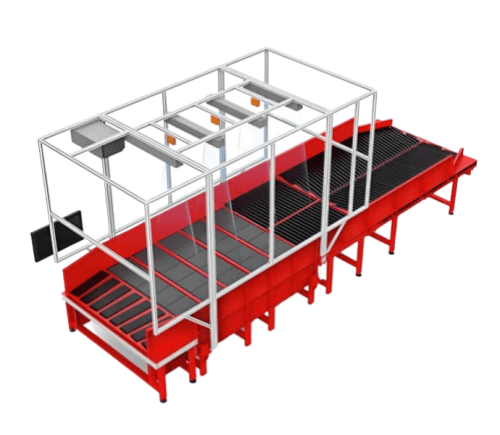
A sorter is rated assuming items arrive singly, evenly spaced and roughly centred - every assumption is created upstream. A cell releasing parcels in bursts of three shows the sorter three times nominal rate, then idle time. Two facilities with identical sorters routinely differ by 30 percent in throughput.
Vision-based systems handle the hard cases well: binocular 3D modelling reconstructs position, contour and reflectivity per item, and a hard-trigger linkage adjusts belt speed across 1.2-2.2 m/s. The engineering is not the weak link. The specification is.
A single separation rate is a marketing number: it counts an item as separate regardless of whether the sorter could use it. Four measurements together describe the cell honestly.
| KPI | What it measures | Downstream effect |
|---|---|---|
| Separation rate | Share of items released singly rather than as a double or clump | Sets re-circulation load; each double becomes a manual fix or a wasted divert |
| Gap consistency | Spread of inter-item gaps, not the average | Decides whether induction has alignment time; wide spread starves the sorter |
| Centre offset | Lateral deviation from belt centreline at hand-off | Consumes the divert window; large offsets force speed reduction |
| Duplicate rate | Items looping back, or counted twice by the vision system | The hidden labour cost, and the reason manifest counts drift |
Ask for all four as distributions, not pass or fail. A cell at 99 percent with a bimodal gap profile underperforms one at 97 percent with a tight profile; the second can be tuned around, the first argued about forever.
Inter-item gap is the only cell output the sorter actually consumes. Yet it is almost never in a purchase contract. The arithmetic is unforgiving: a sorter needing 0.9 seconds per divert and 300 mm of clear belt is served well by a consistent 650 mm gap at 2.0 m/s. A cell averaging 650 mm but alternating 200 mm and 1,100 mm delivers the same average and a fraction of the usable rate.
Specify it this way: ask for the 5th, 50th and 95th percentile of inter-item gap at three belt speeds and two parcel-mix profiles. If a supplier cannot produce that table, the separation rate they quoted is not comparable with anyone else's.
Dynamic centring is usually sold as a convenience. It is better understood as capacity: a divert window is a fixed mechanical allowance, and every millimetre of lateral offset is spent from it before the divert begins. A vision-based cell centres by computing a trajectory rather than pushing items into a guide rail, which matters for soft packs and envelopes, and gives maintenance a diagnostic signal: sudden drift means a camera moved, not that the algorithm degraded.
Most acceptance tests measure good behaviour and ignore bad behaviour. An agreed taxonomy makes disputes resolvable.
| Failure mode | Typical trigger | Correct response |
|---|---|---|
| Doubles released | Overlapping lightweight items below the reflectivity threshold | Re-circulate to a second pass rather than reject to manual |
| Gap collapse | Density surge after a manual loading push | Speed reduction with a queue buffer, not stop-start |
| Centre drift | Camera misalignment or belt tracking fault | Self-diagnostic alert before sort accuracy moves |
The cell and the WCS exchange more than a start signal. A hand-off covers four things.
These documented characteristics are a sensible baseline for a mid-volume express or e-commerce hub.
| Parameter | Specification |
|---|---|
| Conveyor speed | 1.2 - 2.2 m/s, adjustable |
| Separation success rate | 99 percent or better |
| Vision and data | Binocular camera with 3D modelling software, TCP/IP output |
| Control and detection | Hard-trigger line linkage, reflectivity detection at 10 percent threshold |
| Parcel range | 40 g to 60 kg; envelopes from 100 x 150 mm to cartons 600 x 800 mm |
| Environment and power | -10 to 50 degrees C, no more than 75 dB, AC 380V three-phase |
Ask for the four KPIs as rolling time series, not a live dashboard: a dashboard says what is happening now, a time series says what is drifting.

Specifying the cell as data changes the purchase: buyers compare gap distributions, permitted failure rates and hand-off latency instead of one percentage. It also moves the conversation into layout - a cell needing 650 mm of consistent gap needs a specific induction length, Where a facility already runs a vision stage, 2026 guidance on singulation as a throughput ceiling, on cross-belt carrier routing and on DWS-integrated rotary wheel lines is worth reading alongside this article.
Planning a singulation upgrade and want the numbers before the quote? Send your parcel mix, peak volume and layout for a gap-distribution estimate and acceptance-test template.
Email: info [at] zowinda [dot] com | WhatsApp: +86 186 2085 0485 | Product page: WINDA Single-piece Logistics Separation System
Sorter
Wechat QR code
wechat number:Copyright © 2022-2023 Winda, inc. All rights reserved