

Every personalization quotation carries a number like "4,000 to 5,000 cards per hour" and then a parenthesis that decides everything: depends on the data. Buyers read the number and ignore the parenthesis. In practice the parenthesis is the machine. This article decomposes a personalization line into the cycle that truly paces it, and explains why the WINDA IC Card Personalization Machine is specified as 32 ISO 7816 contact stations plus 12 ISO 14443 contactless stations rather than as a single throughput figure.

A blank card is plastic. A personalised card carries a file whose size and cryptographic structure vary enormously: a stored-value transit card might receive 200 bytes, while a dual-interface bank card receives a payment applet, a script and diversified keys, then must be challenged on both interfaces.
Writing time scales with payload, not with card count. Two bureaus running the same model can report 3,800 and 4,900 cards per hour with equal honesty. Ask for a rate table indexed by job type, with the payload assumption behind each row.
At 4,000 cards per hour the line indexes a card every 0.9 seconds. Contact personalisation alone can consume 400 to 900 milliseconds, so in most installations the station, not the transport, is the clock.
| Stage | What it consumes | Typical share of cycle |
|---|---|---|
| Card feed and orientation | Mechanical handling, double-card detection | 5 to 10 percent |
| Contact write and verify | ISO 7816 reset, applet select, script execution, read-back | 35 to 55 percent |
| Contactless write and verify | ISO 14443 anticollision, key diversification, ATS handshake | 20 to 30 percent |
| Print, inspect, sort | Thermal or inkjet head time, CCD capture, divert | 10 to 20 percent |
So a line quoted at 5,000 cards per hour on a light payload will not hold that rate on payment cards, and the cheapest improvement is script optimisation, not hardware.
The most misunderstood parameter in the category. Adding stations to a linear indexing line does not raise the cards-per-hour figure, because the line still releases one card per index step. What more stations buy is the ability to divide a heavy job across parallel writes: split a diversification across four groups and write time falls accordingly.
So ask not how many stations, but how much payload the configuration absorbs inside the index window. A 32-station contact block is a payload budget, and on a mixed book of transit, loyalty and bank work it keeps the line inside its promised rate.
Ask for it in writing: the required index step, the measured write time per station for three named job types, and the resulting sustainable rate. A supplier quoting only a peak number has told you nothing you can plan capacity against.
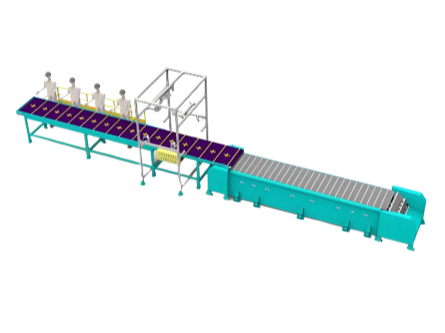
A typical bureau week mixes a government ID reissue, two bank portfolios and a loyalty campaign, each with its own script, artwork and rules. Setup is a first-class cost, and on small lots it dominates.
| Lot size | Setup burden | Where the money goes |
|---|---|---|
| Under 2,000 cards | Dominant; two to three changes per shift | Operator time and scrap from re-validation |
| 2,000 to 20,000 | Moderate; one change per shift | Balanced; rate table is realistic |
| Above 20,000 | Negligible per card | Pure throughput and yield |
The design response is modularity: when each function is a discrete module, a job change means swapping a module and reloading data. Ask for changeover time as a measured number, plus the re-validation step that follows it, because an untested job starting at full rate is a scrap generator.
A blank card costs cents. A personalised card that fails verification is a liability: it may carry keys and personal data and must be destroyed under control, not binned. Yield therefore has a security dimension ordinary scrap does not.
Security discussions usually stop at the host security module, which is the wrong place to stop. The line is where keys are used, and auditors want to know what happened at each station, in order. Three things make that possible: a station-level event log covering card identifier, script version and result; a control that stops an unverified card from progressing; and a documented destruction path for rejects.
This argues for PC plus PLC control over a sealed proprietary controller. The PLC holds deterministic motion and interlock logic; the PC holds job data, verification results and exportable logs. An API and communication port let a bureau management system drive the line instead of an operator screen, which is what makes multi-shift audit practical.
An extra contact station group buys parallel payload capacity, which matters on payment or SIM-class scripts above 600 milliseconds. A contactless group buys dual-interface work in a single pass. IC data checking buys read-back verification before release, on any job where a bad card is a liability. CCD inspection buys print and surface defect detection; embossing or indent modules exist purely to serve legacy formats that still require raised characters.
Test with your own data and job mix, and count rejects as carefully as good cards.
On a 4,500 card hour line over two shifts, one percentage point of yield is about 500 cards a day. At a reissue cost including blank stock, secure destruction and handling, that is often the gap between a four-year and a two-year payback.
Downstream, the line hands cards to sorting and punching equipment: see card sorting throughput, card punching yield and lane granularity in card logistics.
Specifying a personalization line this quarter? Send us your job mix and script sizes and we will return a rate table rather than a peak number, together with the station configuration that supports it.
Email: info [at] zowinda [dot] com | WhatsApp: +86 186 2085 0485
Sorter
Wechat QR code
wechat number:Copyright © 2022-2023 Winda, inc. All rights reserved