

A sorting line is paid for the hours it runs, not the number printed on its datasheet. The Swivel Wheel Sorter Machine Unit is specified at 6,000-10,000 parcels per hour with adjustable wheel speed of 1.0-2.0 m/s, diversion angles from 30 to 90 degrees and accuracy above 99.95 percent. Those figures describe what it can do under stated conditions. This article looks at what keeps it doing them across a shift: wear parts, jam recovery, cleaning discipline and idle energy.
The gap between 6,000 and 10,000 parcels per hour is not a mystery - it is the difference between a line running at full wheel speed with clean, well-fed parcels and a line stopping to clear a jam, wait for induction or recover from a misread label. A sorter at 10,000 per hour that loses 15 percent of its time to stops delivers roughly 8,500 per hour across a shift. A unit at 8,000 that runs steadily can beat it. That is why uptime, not peak speed, is the number to put in a business case.
Three separate multipliers matter: availability (how much scheduled time the machine is actually sorting), utilisation (how much of that time has parcels to sort) and first-pass accuracy (how much output needs no re-handling). A PLC plus WCS control system with automatic fault detection helps with availability, but it cannot fix a dirty wheel deck or poor induction. The same distinction appears in nameplate versus real throughput on larger sorters.
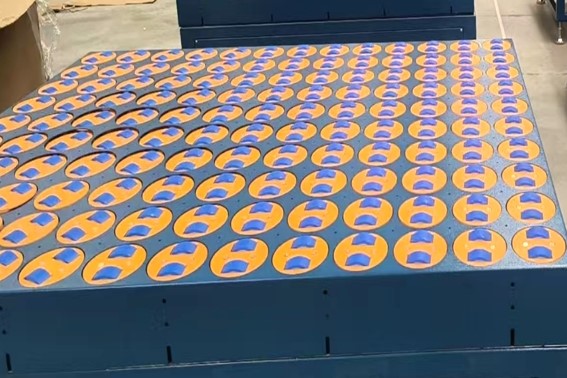
A swivel wheel deck has few moving parts compared with a cross-belt, but the ones it has are loaded continuously. Wheels and their bearings see repeated directional changes; the soft contact surface that protects parcels also picks up label adhesive, paper dust and packaging fines. As contamination builds, grip changes and a wheel that once diverted cleanly begins to slip or push a parcel off-centre. The result is rarely a dramatic failure - it is a slow rise in misroutes and small jams that operators learn to live with.
The practical response is a documented cleaning and inspection cadence, not a reactive call when accuracy drops. Because the deck is modular, a worn wheel unit can be swapped without rebuilding a section. In 2026 the trend is condition monitoring: tracking motor current and fault events through the WCS so a rising count triggers service before the line stops. Ask which components are consumables, their expected life, and whether a spare kit ships with the machine.
| Check | Frequency | Failure it prevents |
|---|---|---|
| Clear deck and sensor lenses | Each shift | Misreads from dust and label residue |
| Inspect wheel surfaces and bearings | Weekly | Slip, off-centre diversion, rising jams |
| Verify diverter angle and speed settings | Monthly | Drift after configuration changes |
| Review WCS fault log and spare usage | Quarterly | Chronic faults hidden by manual recovery |
Clearing a single jam takes a minute or two once an operator walks to the deck. At 10,000 parcels per hour, that is roughly 170 to 330 parcels of lost opportunity - more than an entire small order wave. Two stops an hour can erase the advantage of the higher speed setting. Automatic fault detection in the WCS shortens diagnosis, but physical access and a clear recovery procedure determine how fast the line restarts.
Record jam count and recovery time separately. A high count with fast recovery points to induction quality; a low count with slow recovery points to layout and training. This is the logic behind exception handling as an economic variable. Fix the cause before raising wheel speed - a faster machine repeats its faults more often.
Soft swivel wheel contact is what makes the unit suitable for fragile goods and for mixed parcel sizes from 80x80x10 mm up to 500x700x350 mm, at weights from 0.03 to 20 kg. Gentle diversion reduces crushed corners and damaged contents, which matters when the sorted items are retail stock or customer orders rather than durable industrial parts. The trade-off is that a compliant contact surface is more sensitive to contamination and to parcels with loose wrapping or protruding labels.
Track damage rate beside misroute rate. A line can show excellent accuracy and still create rejects by scuffing or deforming goods. If damage rises while accuracy holds, the cause is usually surface condition, wrapping quality or an aggressive angle setting - not the sorting logic. Diversion angles from 30 to 90 degrees are customisable precisely because different sites need different trade-offs between gentle handoff and destination geometry.
| Metric | How to measure it | Why it predicts uptime |
|---|---|---|
| Sustained rate | Best two hours of a 72-hour soak | Separates peak from repeatable output |
| Misroutes per 10,000 | Count over full soak, not a sample | Exposes slow contamination drift |
| Jams and mean recovery time | Log every stop with timestamp | Quantifies the hidden speed tax |
| Damage rate | Inspect a defined sample per lane | Catches gentle-handling regressions |
The unit runs on 380V/50Hz power with a low-consumption design and an intelligent sleep mode. That matters most in sites where parcel flow is strongly peaked: an e-commerce fulfilment centre may see a morning surge, a quiet afternoon and a second evening wave. A machine that sleeps between waves spends less of the day consuming full power while producing nothing. Compare energy per thousand sorted parcels, not just installed power, when building an operating-cost model.
Energy accounting also rewards scheduling: running one sorter in its efficient band is usually cheaper than two machines at partial load. For the retrofit logic, see right-sized DWS sorting lines and lane granularity decisions.
With a compact footprint and flexible installation, the swivel wheel unit is often chosen for brownfield sites that cannot give up floor space to a large loop. It integrates with DWS systems and with PLC plus WCS control on Windows or Linux, so it can be added to an existing data flow rather than treated as an isolated island. Standard lead time is 8 to 12 weeks after order confirmation, which makes the maintenance plan and spare kit part of the purchase conversation rather than an afterthought.
Against a cross-belt sorter, the swivel wheel deck trades top-end speed for a smaller footprint and simpler mechanics; against manual diversion, it trades flexibility for repeatability and traceable lane data. In a year when buyers are asked to justify automation with measured operating cost, that middle position is increasingly the practical choice - provided the uptime numbers are witnessed, not assumed.
The most useful evaluation is a witnessed run on your own parcels with jam counts, recovery times and damage samples recorded alongside throughput. Against those figures, 6,000-10,000 parcels per hour and 99.95 percent accuracy become a maintenance plan, not a brochure line.
Related reading: our swivel wheel sorter overview covers the platform and its routing options.
For a layout review, a sample-run slot or a factory-direct quotation, contact WINDA at info [at] zowinda [dot] com - Zowinda Technology Co., Ltd. will map the unit to your parcel mix and lane geometry within one business day.
Sorter
Wechat QR code
wechat number:Copyright © 2022-2023 Winda, inc. All rights reserved